A new stress-response pathway in Mycobacterium tuberculosis

A new stress-response pathway in Mycobacterium tuberculosis
van der Velden, P. M.; Merx, J.; van Dijk, L.; Roos, F.; Brake, J.; Berben, T.; White, P. B.; de Graaf, R. M.; Terschlusen, E.; van Weerdenburg, I. J.; Zhang, B. H.; van Crevel, R.; van Niftrik, L.; van Ingen, J.; Boltje, T. J.; Jansen, R. S.
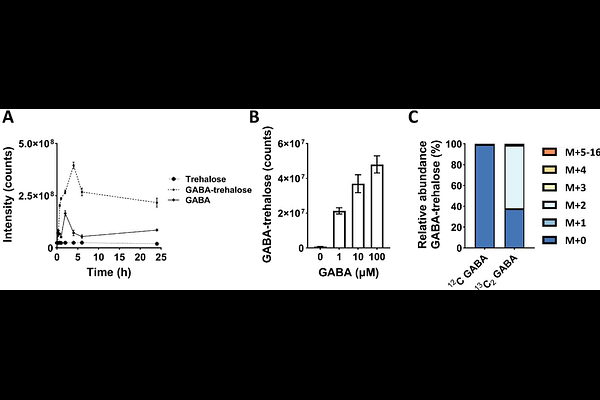
AbstractMetabolic adaptations are key in the virulence of the pathogen Mycobacterium tuberculosis (Mtb). However, our current understanding of these adaptations is limited to common pathways in central carbon metabolism. Here we apply an untargeted bottom-up approach to discover unknown stress-responsive metabolites and their biosynthetic enzyme. We show that upon exposure to hypoxia, nitric oxide and activated macrophages, Mtb rapidly produces high levels of an unknown metabolite that we identify as 6'-{gamma}-amino-butyric acid-trehalose (GABA-trehalose). Formation of millimolar GABA-trehalose levels under these stresses is driven by a rapid rise in GABA, which is also excreted. We demonstrate that GABA-trehalose is produced from GABA and trehalose by the uncharacterized ATP-grasp enzyme Rv1722, involving a carboxylate-hydroxyl ligation that is non-canonical for ATP-grasp enzymes. Phylogenetic analyses demonstrate that the gene rv1722 is present in most slow-growing mycobacteria but absent in most rapid-growing mycobacteria. While the role of GABA-trehalose in Mtb metabolism remains unclear, we postulate that the increased NADH/NAD+ ratio under hypoxia and nitric oxide exposure promotes GABA formation and inhibits its breakdown, leading to GABA accumulation and excretion. Rv1722-driven coupling of GABA and trehalose constitutes an alternative to excretion that conserves carbon and nitrogen. Taken together, our bottom-up approach reveals a new stress-response pathway in Mtb that rapidly produces large quantities of GABA-trehalose. These findings extend our knowledge of the metabolic adaptations that a major human pathogen utilizes in response to immune system-imposed stresses.