CASCADE recovers promoter-associated regulatory motifs from cell-type-resolved DNA language-model attributions

CASCADE recovers promoter-associated regulatory motifs from cell-type-resolved DNA language-model attributions
Farghadan, A.; Schmitz, R. J.; Jackson, S. A.; Pickering, E.
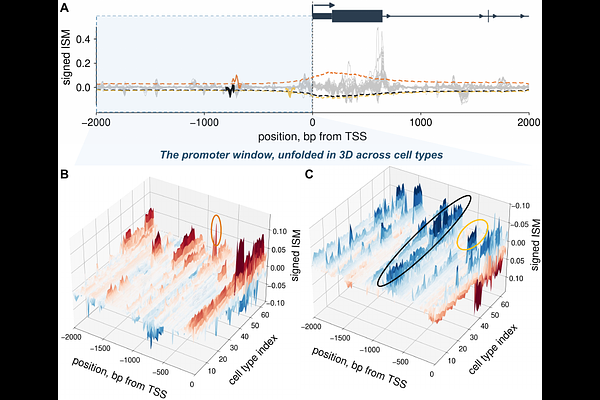
AbstractGene expression is governed by regulatory DNA and their associated trans factors acting in specific cell types, yet the sequences underlying this control remain poorly mapped in plants. Genome-pretrained DNA language models provide a route to interrogate regulatory sequence directly, but their attributions have largely been interpreted using bulk or whole-tissue data, and standard attribution pipelines can preferentially highlight sequences downstream of the transcription start (TSS) site rather than promoter-associated signals. Here, we train a cell-type-resolved sequence-to-expression model from a single-cell soybean (Glycine max) atlas by coupling a soybean-adapted Genomic Pre-trained Network (GPN) to a shared sequence encoder with 66 cell-type-specific output heads. Across 38,339 protein-coding genes, the model achieves a mean per-cell-type, across-gene Pearson correlation of 0.683 and, recast as a high-versus-low expression classification, reaches an area under the ROC curve of 0.92 to 0.97 across tissues, at or above dedicated plant sequence models. We then introduce Context-Aware Significance of Cross-gene Attribution for Discovering Elements (CASCADE), a position-specific statistical framework for identifying model-derived candidate regulatory elements from in silico saturation mutagenesis. Relative to the pooled null used by TF-MoDISco, CASCADE shifts motif recovery from downstream of the transcription start site toward promoter sequence, with 77% of CASCADE-exclusive motifs, compared with 12% of TF-MoDISco-exclusive motifs, falling within the promoter. Applied across the atlas, CASCADE identifies approximately 1.39 million candidate elements spanning broadly active, tissue-restricted and cell-type-restricted classes. Together, these analyses establish a position-aware approach for extracting promoter-associated regulatory hypotheses from sequence models and generate a cell-type-resolved map of candidate cis-regulatory elements.