A high-throughput, 3D microtissue platform for multiparametric analysis of tissue remodeling.

A high-throughput, 3D microtissue platform for multiparametric analysis of tissue remodeling.
Vasan, A.; Nguyen, Q.; Davis, E.; Karakan, M. C.; Westphal, E.; Shah, V.; Wong, W.; Lejeune, E.; Eyckmans, J.
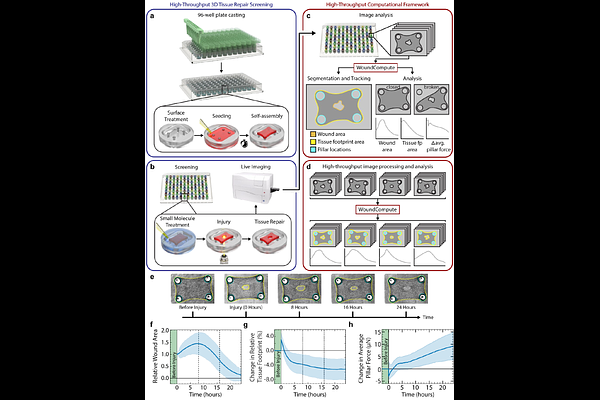
AbstractExtracellular matrix (ECM) remodeling and force generation are fundamental drivers of tissue morphogenesis and repair, yet scalable methods to quantitatively interrogate these dynamic mechanical processes remain limited. Here, we present a high-throughput screening platform that integrates engineered three-dimensional (3D) microtissues within a standardized 96-well format. We introduce a robust mold-casting fabrication process and a layer-by-layer surface modification strategy, that ensures long-term tissue stability and prevents detachment (95% tissue formation success; stable in culture for more than 10 days). This system enables simultaneous, longitudinal quantification of tissue closure, tissue contractility, and tissue compaction from a phase-contrast imaging modality. The computational data analysis tools that accompany this framework ensure reproducibility through deterministic computation and accelerate data extraction 80-fold relative to manual annotation. Using pharmacological compounds, we show that tissue closure dynamics, force generation, and compaction represent independent variables of ECM-driven tissue remodeling, challenging assumptions embedded in commonly used contraction-based assays. Furthermore, benchmarking against reported clinical drug responses demonstrates that the 3D platform better aligns with clinical outcomes (Kendall {tau}-b = 0.72, p=0.045, n =8/10) than a conventional two-dimensional scratch wound assay (Kendall {tau}-b = 0.52, p=0.25, n =4/10). Together, this work establishes a scalable assay for functional screening and quantitative assessment of tissue remodeling dynamics in three-dimensional systems.