Lipid Nanoparticles for Spleen-Targeted RNA delivery

Lipid Nanoparticles for Spleen-Targeted RNA delivery
Vlasova, K.; Aibani, N.; Sanyal, M.; Herrera, M.; Deyati, A.; Helmy, E.; Pierrot, H.; Jumaa, S.; Arriaza, D.; Tsai, M.-C.; Majeti, R.; Greenleaf, W.; Thomas, A.; Chang, H.
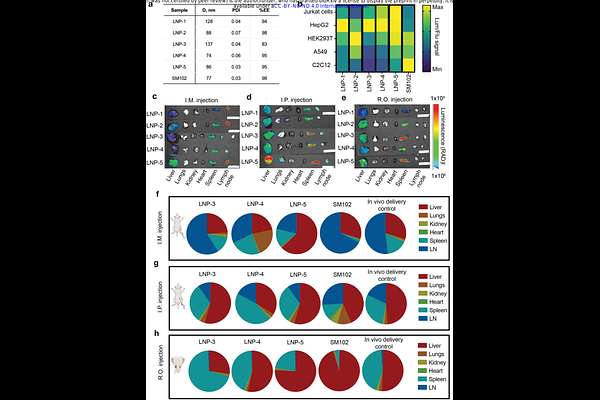
AbstractLipid nanoparticles (LNPs) formulated with neutral helper lipids efficiently deliver RNA to the liver in pre-clinical models and humans but achieving clinically relevant delivery to other tissues remains a major challenge. To reduce liver uptake, targeting strategies often range from active targeting relying on antibodies to quasi-active targeting by employing permanently charged helper lipids which influence biodistribution after administration. In this study, we present an alternative approach based on varying ionizable lipids and stabilizers, along with optimizing formulation parameters for targeted delivery of circular RNA via a passive targeting approach. We generated a library of 216 LNP formulations and evaluated their performance in vitro in Jurkat cells and human primary T cells. The lead LNPs showcasing activity in both Jurkat and T cells were explored for their efficacy in vivo via multiple routes of administrations. Our results show that both the identity of stabilizer and ionizable lipid had effects on decreasing hepatic vs. splenic delivery while enhancing splenic accumulation. In line with this improved tissue tropism, spleen-tropic LNPs induced distinct transcriptomic remodeling in vivo compared with conventional, FDA-approved SM-102 LNPs. These findings demonstrate that extrahepatic targeting of LNPs can be achieved without altering charge of the LNPs and further reveal that hepatic de-targeting efficiency could be influenced by the immune status of the recipient.