Lifetime-based multiplexed detection of viral RNA using fluorogenic aptamers

Lifetime-based multiplexed detection of viral RNA using fluorogenic aptamers
Chen, Y.-I.; Kuo, Y.-A.; He, Y.; Siraj, N.; Batchelder-Schwab, E. J.; Chang, Y.-J.; Yonas, S.; Wu, Y.; Yang, Z.; Nguyen, A.-T.; Kim, S.; Lu, Y.; Mao, C.; Ren, P.; Yeh, H.-C.
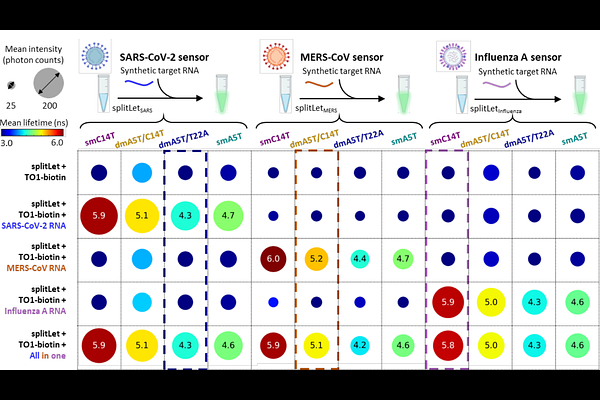
AbstractFluorogenic aptamers (FAPs) are emerging molecular probes for viral RNA and DNA sensing. However, their use in multiplexed nucleic acid sensing has been hindered by cross-reactivity and overlapping emission spectra. Here we address these limitations by introducing a fluorescence-lifetime-based multiplexed detection strategy using variants of the DNA fluorogenic aptamer Lettuce that exhibits distinct fluorescence lifetimes when complexed with the fluorogen TO1-biotin. To effectively evolve Lettuce for diverse lifetimes, we developed a large-scale screening platform, termed FAP-FLIM-NGS (fluorogenic aptamer-based fluorescence lifetime imaging microscopy on next-generation sequencing chips), which measures the fluorescence lifetimes of ~10^4 Lettuce/TO1-biotin complexes directly on an Illumina MiSeq flow cell. Using this approach, three variants with markedly different lifetimes were identified: a single mutant (smC14T, 6.0 ns) and two double mutants (dmA5T/C14T, 5.2 ns, and dmA5T/T22A, 4.4 ns). To demonstrate the utility of these Lettuce variants in multiplexed detection, a set of split Lettuce probes targeting viral RNA fragments derived from SARS-CoV-2, MERS-CoV, and influenza A were designed and tested. Phasor plot analysis confirmed that these probes can robustly distinguish individual targets as well as mixtures containing any two or all three targets purely based on distinct fluorescence lifetimes of probes, thereby overcoming the challenges of cross-reactivity and spectral overlap. Beyond this proof of concept, our findings establish a generalizable strategy for engineering FAPs with customized photophysical properties, opening new avenues for next-generation diagnostics and molecular sensing technologies.