Contact- and diffusion-based allelopathic interaction of a seaweed with coral holobionts

Contact- and diffusion-based allelopathic interaction of a seaweed with coral holobionts
Tang, P. Y. P.; Pereyra, J. P. A.; Lee, L. K.; McDougald, D.; Rice, S. A.; Deignan, L. K.; Case, R. J.
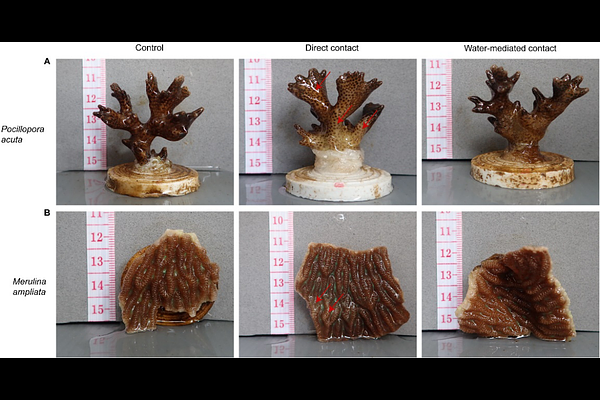
AbstractShifts from coral-dominated to macroalgal-dominated reef systems have become increasingly common in many coastal regions worldwide. Coral-macroalgal interactions have been shown to be generally detrimental to coral health, with macroalgal allelopathic compounds able to exert serious and even lethal effects on coral at various stages of growth and development. Previous studies have shown that the coral-associated microbial communities play important roles in coral health and mitigating external environmental stress, including macroalgal contact stress. However, it remains unclear whether changes in the coral microbiome have an influence on the Symbiodiniaceae community composition, and if such changes subsequently affect coral health. In this study, we examined changes in both the coral microbiome and the Symbiodiniaceae communities of two Singaporean coral species (Pocillopora acuta and Merulina ampliata) when exposed to both direct and water-mediated macroalgal contact with Lobophora sp. This was investigated using 16S rRNA gene amplicon sequencing to characterize the coral microbiome, and ITS2 variable region sequencing to profile the Symbiodiniaceae communities. Although no significant differences were observed for the coral microbiomes and Symbiodiniaceae communities at both alpha- and beta- diversity levels between control and macroalgal contact treated fragments within each coral species, inter-colony variations in responses to macroalgal contact were observed for both the coral microbiome and Symbiodiniaceae communities of M. ampliata. These results suggest that coral colonies vary in the mechanisms that allow mitigation of the effects of macroalgal contact, and in their resilience to macroalgal-induced stress.