Bioengineering of a Chimeric Metarhizium anisopliae cPr1A Protease with Enhanced Binding and Enzyme Activity Through C-terminal Fusion of Bombyx mori Chitin-Binding Domain

Bioengineering of a Chimeric Metarhizium anisopliae cPr1A Protease with Enhanced Binding and Enzyme Activity Through C-terminal Fusion of Bombyx mori Chitin-Binding Domain
Maurya, N.; Saini, G. K.
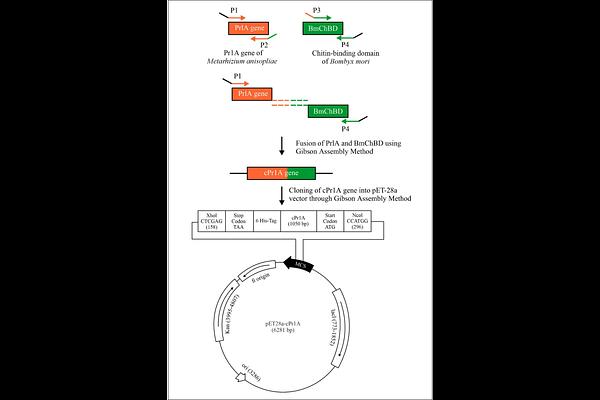
AbstractAbstract Metarhizium anisopliae is an important entomopathogenic fungi used in biological control of agricultural pests, but its commercial application is limited by relatively slow host mortality. This study aimed to engineer a chimeric protease (cPr1A) with enhanced binding affinity and protease activity against insect cuticle. We hypothesized that stronger cuticle binding would increase local enzyme concentration at the cuticle surface and thereby enhance cuticle degradation. To achieve this, the Bombyx mori chitin-binding domain (BmCBD) was fused to the C-terminus of the Pr1A protease from M. anisopliae. Recombinant Pr1A and cPr1A were expressed in Escherichia coli, purified by Ni-NTA affinity chromatography. Binding and protease activity were assayed in triplicate using Samia ricini cuticle powder as substrate. Results are presented as mean +/- SEM. The chimeric protease cPr1A showed a 28.9% increase in cuticle binding compared to wild-type Pr1A (15.81 +/- 1.97 vs. 12.27 +/- 2.13 g bound protein/mg cuticle powder; p < 0.002) and a 35% increase in protease activity (0.343 +/- 0.08 U/mg vs. 0.254 +/- 0.06 U/mg; p < 0.03). These results indicate that cPr1A is a promising candidate for overexpression in M. anisopliae to enhance cuticle degradation and potentially improve fungal virulence against insect pests.