Geometric characteristics of cubically symmetric and triply periodic scaffolds for optimal cell migration

Geometric characteristics of cubically symmetric and triply periodic scaffolds for optimal cell migration
Lonati, C.; Preziosi, L.
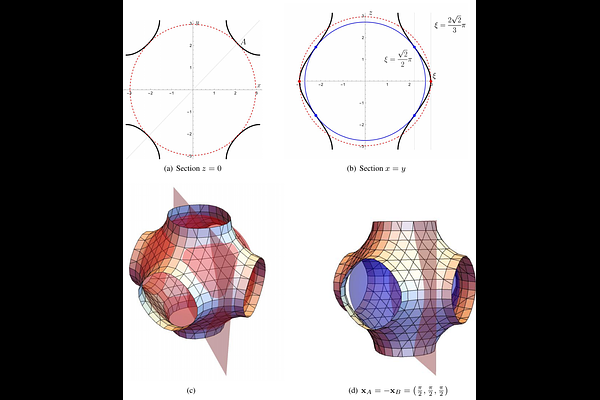
AbstractIn tissue engineering, it is important to conceive and construct artificial bio-mimetic scaffolds able to foster cell migration as this is a fundamental process in wound healing and tissue regeneration. In order to do that, cubically symmetric and triply periodic porous structures have been identified as promising candidates for instance for the reconstruction of artificial cartilages and bones, also due to their tunable mechanical characteristics and highly inter-connected porous architectures that mimic the trabecular bone hyperboloidal topography. We propose here a mathematical approach that might be helpful to identify what are the best geometrical characteristics of such scaffolds, in order to promote cell migration into the porous structures and speed-up their re-population. The method is based on the observation that cell nucleus deformations should be avoided, yet assuring a good possibility for the cell to reach the wall of the porous structure. Mathematically speaking, this leads to the problem of identifying the size of the largest sphere that can pass, without being stuck, through the pores of the bio-mimetic scaffold.