Developmental Arrest Associated with Altered Cerebellar Metabolism in Sudden Infant Death Syndrome

Developmental Arrest Associated with Altered Cerebellar Metabolism in Sudden Infant Death Syndrome
Ghaemmaghami, J.; Simonti, G.; Sanidas, G.; Wolff, N.; Triantafyllou, M.; Trejo, R. C.; Pettersen, H. S.; Gallo, V.; Koutroulis, I.; Kratimenos, P.
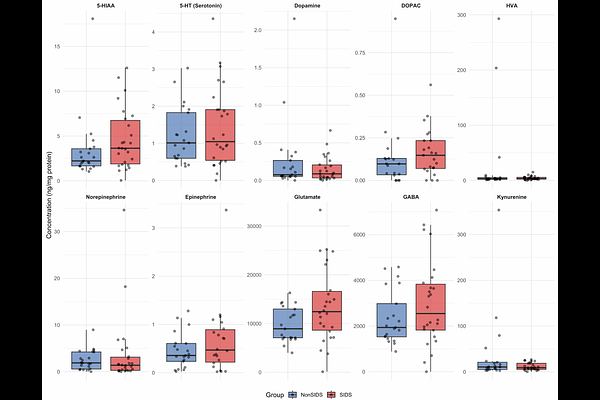
AbstractBackground Effective autoresuscitation during hypoxic stress demands the cerebellum integrate autonomic and arousal responses. It remains unknown if the SIDS cerebellum possesses the metabolic stability and developmental maturity to sustain this function. We aimed to define if cerebellar dysfunction constitutes a silent failure point within the central respiratory network. Methods We performed multi-omic integration of RNA-sequencing, targeted metabolomics, and quantitative histology on postmortem cerebellar tissue from SIDS infants and age-matched controls. Cross-omic concordance analysis mapped the relationship between metabolite abundance and the transcriptional directionality of corresponding metabolic enzymes. Results The SIDS cerebellum revealed a distinct profile defined by neuroinflammation and altered GABA and glutamate metabolism. Targeted metabolomics confirmed a metabolic imbalance with significantly elevated glutamate and GABA (P < 0.05). Quantitative histology exposed concurrent developmental arrest; persistent external granule layers highlighted morphological immaturity, explaining the failure to mount effective compensatory responses. Conclusions Metabolic pathology in the SIDS cerebellum is intrinsically linked to structural immaturity. This developmental arrest creates a compromised environment lacking the metabolic competence to support neural homeostasis, preventing critical arousal responses required for survival.