Mutations that positively affect Bandavirus glycoprotein function on VSV vectored vaccines

Mutations that positively affect Bandavirus glycoprotein function on VSV vectored vaccines
Petch, R. J.; Hicks, P.; Westover, J. B.; Gowen, B. B.; Bates, P.
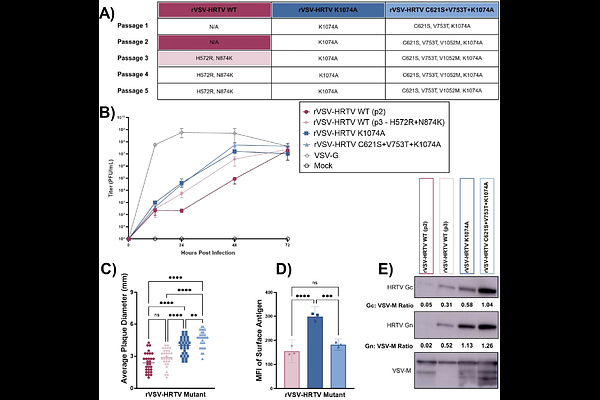
AbstractSevere fever with thrombocytopenia syndrome virus (SFTSV) and Heartland virus (HRTV) are emerging tick-borne bandaviruses. They have high case fatality rates (10%), and no FDA-approved vaccines exist for disease prevention. SFTSV and HRTV are therefore identified as priority pathogens. A recombinant vesicular stomatitis virus (rVSV) vaccine, which replaces the original VSV glycoprotein with the SFTSV glycoproteins, shows early promise for SFTSV as it induces strong immune responses that are protective against lethal challenge. However, rVSV-SFTSV is highly attenuated in cell culture, which may be due to incompatibility between the assembly sites of SFTSV (the Golgi and ERGIC) and that of VSV (the plasma membrane). In this study, we identify a noncanonical COPI binding motif found in the cytoplasmic tail of SFTSV glycoproteins and demonstrate that an amino acid substitution in this motif (K1071A) inhibits binding to COPI. This mutation results in increased surface expression of SFTSV glycoproteins, improved incorporation onto VSV virions, and enhanced replication of rVSV-SFSTV in vitro. A mutation in a homologous site (K1074A) of HRTV has similar results, and rVSV-HRTV K1074A exhibits increased replication in vitro and in vivo. We show that vaccination with rVSV-HRTV K1074A results in improved induction of neutralizing antibody responses in immunocompetent C57BL/6 mice, and neutralizing antibodies elicited by vaccination are protective when administered to severely immunocompromised mice via passive transfer. Overall, our study identifies a mutation that improves the efficacy of the rVSV-SFTSV vaccine candidate and introduces the first vaccine candidate directly addressing HRTV infections.