A flexible modelling framework for estimating thermal tolerance and sensitivity

A flexible modelling framework for estimating thermal tolerance and sensitivity
Noble, D. W. A.; Arnold, P. A.; Nakagawa, S.; Pottier, P.
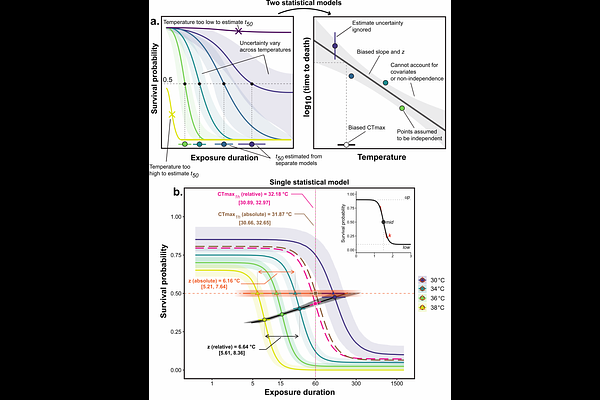
AbstractExtreme heat events are becoming more frequent, intense and prolonged, making it urgent to predict how heat intensity and exposure duration combine to threaten organisms. Thermal death time (TDT) and thermal load sensitivity (TLS) models provide this link, but conventional two-stage analyses often discard uncertainty, mishandle censored or overdispersed data and limit inference. Here, we show how the four-parameter log-logistic model can recover TDT/TLS quantities, including thermal tolerance (CTmax), sensitivity (z), critical temperature (Tcrit), heat injury and survival, from one model. Simulations show the joint model reproduces classical estimates when two-stage assumptions hold and is more reliable when they fail. We introduce these workflows as Bayesian and frequentist R packages. Case studies across plant and animal taxa demonstrate this modelling framework can estimate group contrasts and predict survival from realistic field temperature-time series. This framework provides more robust inference and flexible tools for predicting organismal responses to extreme heat events.