Complex patterns of biological connectivity highlight risks of local depletion in an Australian fishery

Complex patterns of biological connectivity highlight risks of local depletion in an Australian fishery
Brown, L.; Whiterod, N.; Rizzari, J.; Barnes, T.; Morrongiello, J.; Lieschke, J.; Miller, A.
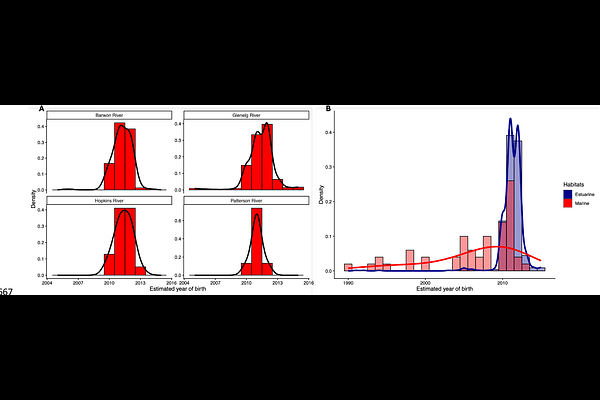
AbstractSustainable management of commercial and recreational fisheries depends on accurately resolving population connectivity, across both ecological and evolutionary timescales. However, dispersal can vary markedly among life stages, making stock connectivity difficult to resolve using single-method approaches that often differ in spatio temporal resolution. Here, we integrated population genomics, otolith stable isotope chemistry, and mark recapture analyses to provide a multi-faceted assessment of stock connectivity in mulloway (Argyrosomus japonicus). Mulloway are a commercially, culturally, and recreationally important estuary associated fish distributed throughout the Indo Pacific region, including south-eastern Australia where this study was conducted. Genome-wide single nucleotide polymorphism (SNP) analyses revealed significant genetic differentiation between regions influenced by different current systems, but limited structure within regions across distances exceeding 900 km. In contrast, otolith C and O signatures revealed fine-scale spatial structuring among estuaries, consistent with prolonged occupancy of local habitats. Mark recapture analyses supported this interpretation, with most fish exhibiting strong estuarine fidelity over extended periods despite occasional long distance coastal movements. Reconstructed age structures from fish otoliths revealed remarkably similar cohort composition among estuaries, with populations dominated by cohorts originating from a major recruitment pulse centred on 2011 and 2012, likely associated with a broad-scale flood-driven spawning and recruitment event. Together, our findings indicate that mulloway fisheries function as regionally connected networks of partially independent estuarine assemblages, where strong local residency is periodically offset by dispersive individuals and episodic recruitment events that maintain long-term demographic and genetic connectivity. Consequently, local estuarine populations may be vulnerable to localised depletion despite broader regional connectivity, particularly where sustained fishing pressure coincides with reductions in freshwater flows that constrain spawning and recruitment. More broadly, our study demonstrates the value of integrating complementary approaches to identify biological connections and define meaningful management units in species with complex life histories.