Untargeted metabolomics reveals host responses and metabolites linked to host compatibility in Rafflesiaceae parasitism

Untargeted metabolomics reveals host responses and metabolites linked to host compatibility in Rafflesiaceae parasitism
Molina, J.; Abzalimov, R.; Yin, P.; Wicaksono, A.; Bernier, F.; Hill, J.; Burger, M.; Wen, J.; Pell, S. K.
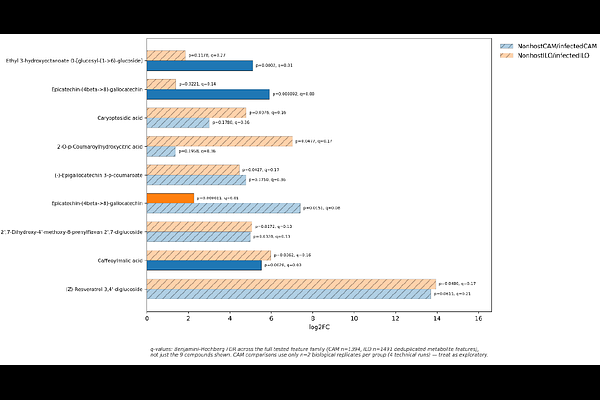
AbstractRafflesiaceae, including Rafflesia, Sapria, and Rhizanthes, are some of the rarest flowering plants in the world, known for producing the largest blooms on Earth. These holoparasites depend exclusively on Tetrastigma (Vitaceae) vines, yet the chemical basis for this host specificity is poorly understood, complicating conservation efforts. Untargeted negative-ion LC-MS metabolomics was used to profile Rafflesiaceae buds and seeds, infected Tetrastigma hosts associated with Rafflesia lagascae, R. speciosa, and Sapria himalayana, uninfected Tetrastigma hosts, and corresponding non-host species from the Philippines and Thailand. Python scripts used for data processing and visualization were developed with generative AI assistance and validated by the authors. Principal component analysis revealed distinct metabolomic profiles across samples, with significant shifts in host metabolites upon infection. Infected Tetrastigma tissues showed nominal enrichment in phenylpropanoid and gibberellin-related metabolites, suggestive of defense and hormonal pathway activation during Rafflesia infection, as well as citric acid, suggesting increased energy demand to support the parasite. Non-host Tetrastigma species showed nominal enrichment in metabolites putatively annotated as stilbenoids, resveratrol diglucosides, and condensed tannins such as procyanidin B2, compounds broadly associated with plant defense. Rafflesia seeds harbored fatty acids/oxylipins, while Rafflesia buds accumulated gallic acid derivatives, compounds also reported in galls. These findings support a chemically mediated model of host compatibility and parasitism, with implications for the ex-situ conservation of these endangered plants.