Chemokine receptor activity is differentially regulated by membrane cholesterol

Chemokine receptor activity is differentially regulated by membrane cholesterol
Salgado-Polo, F.; Fernandez-Gonzalez, J.; Ferrera-Mena, C.; Subedi, S.; Tiruvadi-Krishnan, S.; Rainsford, P. B.; Regmi, R.; Lamichhane, R.; Gustavsson, M.
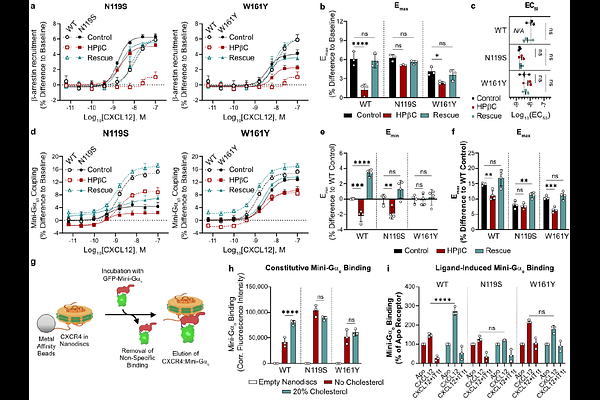
AbstractCholesterol is a key membrane component that regulates G protein-coupled receptor (GPCR) function, yet its molecular mechanisms remain unclear. Here, we combine chemical extraction of membrane sterols with functional signaling assays and single-molecule fluorescence resonance energy transfer (smFRET) to define how cholesterol controls activation of chemokine receptors. Reduction of membrane cholesterol in mammalian cells selectively decreased constitutive and agonist-induced signaling across CXCR1, CXCR2, CXCR4, while it activated ACKR3, and did not affect CXCR3, revealing receptor-specific dependence on membrane sterols. Mechanistically, cholesterol regulation partly required the conserved class A GPCR residue Trp4.50 and shifted agonist-bound CXCR4 toward active conformational states, providing a molecular explanation for its functional effects. In contrast, replenishment with oxidized cholesterol species failed to restore receptor activity, distinguishing cholesterol from oxysterols as modulators of receptor activation. Our findings identify cholesterol as an allosteric regulator of chemokine receptors and suggest that oxysterols may reshape inflammatory signaling by selectively modulating GPCR activity.