Molecular Basis of High-light Adaptation in Cyanobacteria and Cyanophages through the D1/D2 subunits of Photosystem II

Molecular Basis of High-light Adaptation in Cyanobacteria and Cyanophages through the D1/D2 subunits of Photosystem II
Ma, R.; Wu, R.; Morrison, G.
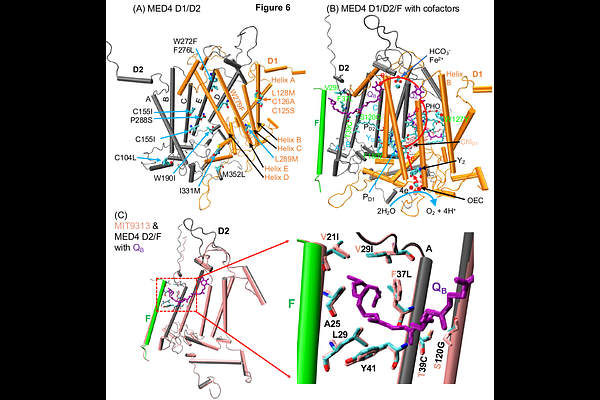
AbstractHigh-light (HL) stress imposes substantial pressure on oxygenic photosynthesis by promoting the formation of reactive oxygen species (ROS) and photodamage in Photosystem II (PSII), particularly within its reaction-center core subunits D1 and D2. Prochlorococcus and Synechococcus, along with their cyanophages, dominate oligotrophic oceans and experience persistent HL exposure, yet the molecular basis of PSII adaptation in these systems remains poorly understood. In this manuscript, we integrate large-scale phylogenetic analysis with residue-level sequence comparison and AlphaFold3-based structural prediction to investigate D1/D2 across Prochlorococcus ecotypes, Synechococcus, and their associated cyanophages. Prochlorococcus species are known to form ecotypes based on light conditions, and the D1 and D2 phylogenies showed consistent organization across our phylogenetic trees. Synechococcus does not fall into the same light-based ecotypes, but we found that D1 and D2 isoforms still form meaningful clusters for these species. Cyanophage-encoded D1 and D2 sequences did not form separate viral clades, but instead were embedded within host-associated diversity and showed closer affinity to HL-adapted Prochlorococcus than to low-light-adapted (LL) lineages. Mapping ecotype- and phage-associated substitutions onto predicted D1/D2 structures, with reference to experimental PSII structures, suggested that some LL-to-HL variants in Prochlorococcus may enhance resistance to ROS-associated damage. Some LL-to-HL substitutions increase methionine and cysteine enrichment near redox-active cofactors, potentially improving redox buffering and ROS scavenging. In contrast, others may favor more efficient electron transfer, reduce charge recombination, and thereby limit ROS production. These results support a model in which PSII adaptation in cyanobacteria is shaped by fine-scale protein-level tuning linked to ecological diversification and cyanophage-host coevolution, with viral-host interactions contributing to the evolutionary optimization of oxygenic photosynthesis under HL stress.