Systematic mapping of insertion-tolerant regions enables capsid engineering of the RNA phage PP7

Systematic mapping of insertion-tolerant regions enables capsid engineering of the RNA phage PP7
Choi, S.-Y.; Kim, M.-J. H.; Kwon, O. H.; Park, C.; Bae, H.-W.; Cho, H.; Cho, Y.-H.
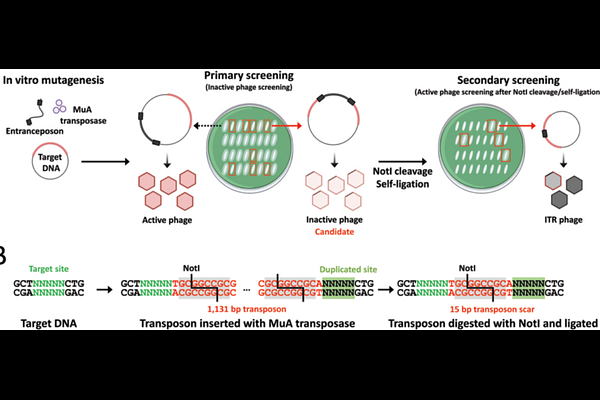
AbstractRNA phages are attractive platforms for the design of programmable bioparticles, but their development has been constrained by limited knowledge of genomic sites that can tolerate sequence insertion. Here, we combined MuA transposase-mediated in vitro insertion mutagenesis with our established reverse genetics systems to systematically identify insertion-tolerant regions (ITRs) in the RNA phages MS2 and PP7. Screening of 4,555 MS2 and 2,228 PP7 random insertion clones identified 29 and 26 nonredundant ITRs, respectively. We further analyzed and compared these ITRs in the context of RNA genome organization and virion architecture. Both phages contained ITRs within the maturation protein (MP), whereas only PP7 tolerated insertions within the coat protein (CP). On the basis of structural location and plaque-forming capacity, an ITR situated between Gly74 and Glu75 (GGC^GAG) in the PP7 CP was selected for further study. Infectious phage particles generated from cDNA clones retained the 15-bp insertion at both the RNA and protein levels. Engineered PP7 phages carrying an RGD motif inserted into the CP at this ITR displayed enhanced in vivo clearance in a Drosophila model, despite having in vitro stability comparable to that of the wild type. These findings provide the first example of CP engineering in an RNA phage and establish a framework for engineering RNA phages for biological and biotechnological applications.