High neuron-microglia interaction at the node of Ranvier predicts recovery in an inflammatory model of Multiple Sclerosis

High neuron-microglia interaction at the node of Ranvier predicts recovery in an inflammatory model of Multiple Sclerosis
Pantazou, V.; Dorcet, G.; Roux, T.; Aigrot, M. S.; Perrot, C.; Mathias, A.; Canales, M.; Lejeune, F.-X.; Stankoff, B.; Du Pasquier, R.; Lubetzki, C.; Desmazieres, A.
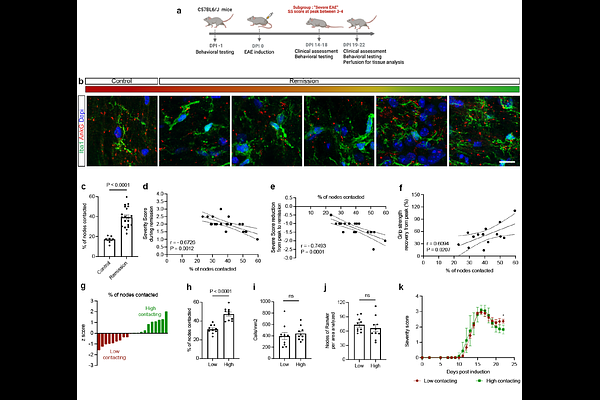
AbstractMicroglia, the resident immune cells of the central nervous system, dynamically respond to their environment in health, injury and disease. They contact axons at the nodes of Ranvier in an activity-dependent manner, a process which contributes to repair, but how adaptive immunity in Multiple Sclerosis (MS) impacts this neuron-microglia crosstalk remains unknown. Using an inflammatory MS model, we identify strengthened microglia-node interactions at remission onset, with marked interindividual variability. Increased engagement correlates with a Th2-related cytokine signature, and IL13/IL4 are sufficient to enhance microglia-node contacts. High interaction levels associate with more pro-regenerative microglia, improved tissue repair and better functional recovery. Low-intensity physical exercise at remission onset further promotes microglia-node interaction, pro-regenerative microglia and improves recovery. Consistently, high microglia-node contact in MS tissue is associated with more extensive remyelination, underscoring this interaction as a key process in repair.