The Thermodynamics of Biomolecular CO2 Capture:Disentangling Equilibria in Amino-Acid-based Systems

The Thermodynamics of Biomolecular CO2 Capture:Disentangling Equilibria in Amino-Acid-based Systems
Petersen, N. C.; Yang, Y.; Nowak, J. S.; Lee, J.-w.; Westh, P.; Otzen, D. E.
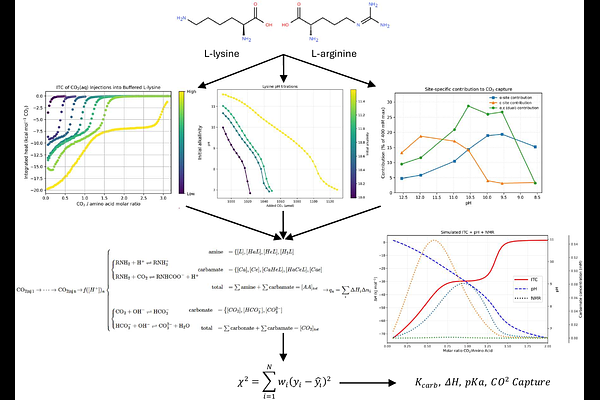
AbstractAmino acids and peptides are promising building blocks for aqueous biomolecular CO2 capture systems, yet the coupled thermodynamics governing carbamate formation, proton transfer, carbonate speciation, and hydration remain difficult to resolve experimentally. Here, we establish isothermal titration calorimetry (ITC) as a quantitative platform for characterizing these coupled processes by integrating calorimetry with pH titrations, NMR spectroscopy, and a mechanistic thermodynamic model. Using L-lysine, L-arginine, and a series of Lys- and Arg-containing peptides, global fitting of ITC thermograms yielded thermodynamic parameters describing protonation and carbamate formation that accurately reproduced independent pH titrations and NMR-derived speciation. The analysis revealed that the characteristic biphasic calorimetric response originates from the coupled carbonate-amine equilibrium network and buffer collapse rather than carbamate saturation. Lys formed -, {epsilon}-, and ,{epsilon}-dicarbamates and exhibited more favorable apparent carbamate thermodynamics than Arg, with the {epsilon}-carbamate lying among the most favorable carbamate-forming amine sites reported for aqueous amines. Model-guided exploration of the fitted thermodynamic landscape further demonstrated that maximizing total CO2 retention, amine-mediated capture, and carbamate formation are distinct optimization problems governed by different combinations of pH, temperature, and CO2 loading. Extension to systematically spaced Lys-containing peptides showed that inter-amine separation alone does not control carbamate stability, highlighting the dominant role of the local thermodynamic environment in biomolecular CO2 capture. This work establishes ITC as a powerful experimental approach for extracting CO2-amine thermodynamics and provides a predictive framework for the rational design and optimization of amino acid-, peptide-, and protein-based carbon capture systems.