The retinal pigment epithelium undergoes anisotropic stretching and nuclear size scaling during optic cup morphogenesis in a fish model.

The retinal pigment epithelium undergoes anisotropic stretching and nuclear size scaling during optic cup morphogenesis in a fish model.
Agnes, F.; Pain, M.; Verite, D.; Zia, P.; Giry, E.; Torres-Paz, J.; Retaux, S.
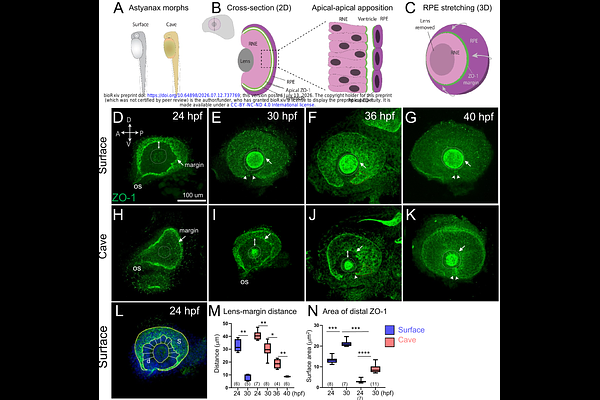
AbstractThe morphogenesis of the optic cup provides a robust system for studying how two apposed epithelial monolayers with distinct properties fold and stretch in a coordinated manner to form the primordial eye. While much research has been conducted on the temporal dynamics of retinal neuroepithelium invagination, the spatial organization and stretching of the retinal pigment epithelium has received less attention. The fish species Astyanax mexicanus offers a unique model to examine the mechanisms of optic tissue morphogenesis through a comparative lens, as it exhibits natural variation in eye development between its river-dwelling and cave-adapted morphs. Using quantitative 3D imaging of optic cups from both morphs, we found that RPE morphogenesis involves transient, graded, and anisotropic cell stretching that patterns the epithelium during optic cup shaping. Analyses of RPE nuclear spacing and cell morphology showed that tissue stretching gradually increases along the proximo-distal axis, suggesting maximal tension in the elongated distal RPE cells aligned along the optic cup meridians. Furthermore, nuclear volumes and apical surface areas of RPE cells scaled spatially along the same axis, independently of endoreplication. In the cavefish natural mutant, RPE expansion was delayed by over six hours and proximal stretching exhibited altered isotropy, indicative of disrupted temporal coordination and suggesting modified mechanical constraints. These results demonstrate that RPE morphogenesis is a highly heterogeneous process from a spatiotemporal perspective, offering new insights into the study of the biomechanical principles of eye development in vertebrates.