A generalized metabolic theory for marine ecosystems

A generalized metabolic theory for marine ecosystems
Tabi, A.
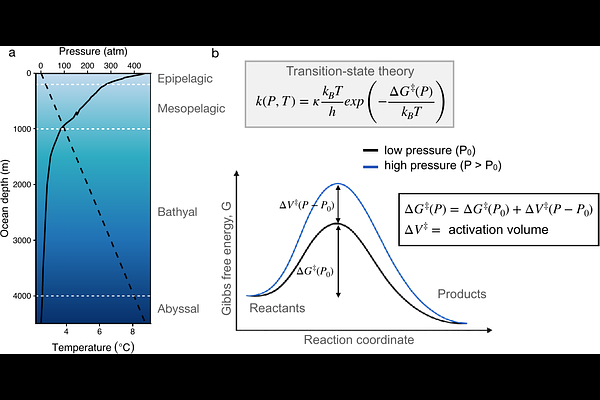
AbstractMarine species inhabit a three-dimensional stratified environment where metabolism is simultaneously influenced by decreasing temperature and increasing hydrostatic pressure with ocean depth. While the Metabolic Theory of Ecology (MTE) incorporates the effects of body mass and temperature, for marine organisms it neglects one of the fundamental thermodynamic state variables governing biochemical reaction kinetics: hydrostatic pressure. We derive a generalized metabolic theory by extending MTE with transition-state theory by explicitly incorporating pressure sensitivity into the Arrhenius formulation. The resulting model predicts that hydrostatic pressure increases the effective activation energy of biochemical reactions, leading to progressively lower metabolic rates with increasing depth. We tested this prediction using a global database comprising 689 metabolic measurements across 11 marine phyla and 22 taxonomic classes. Incorporating hydrostatic pressure substantially improved model performance relative to the classical MTE. Across major marine taxa, activation energy and activation volume varied largely independently, suggesting that pressure adaptation does not require corresponding changes in thermal sensitivity. Our results suggest that hydrostatic pressure is a fundamental thermodynamic constraint that regulates the pace of life across the ocean and consequently the ecological dynamics across Earth's largest biome.