The role of the locus coeruleus in eye movements during perceptual decision making

The role of the locus coeruleus in eye movements during perceptual decision making
Acar, K.; Smith, M. A.
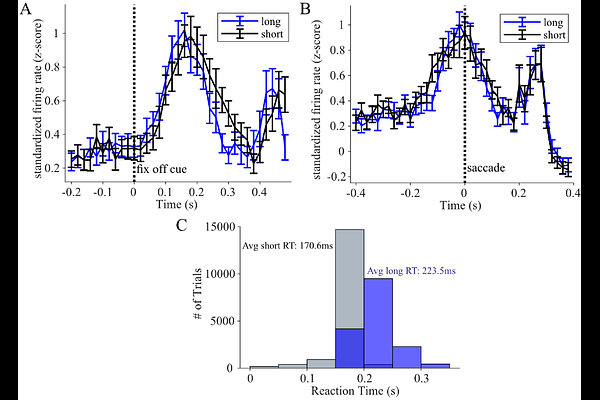
AbstractThe locus coeruleus (LC) is the primary source of norepinephrine in the brain and has been implicated in the processes of attention, arousal, and perceptual decision making. Although prior work has linked transient LC activation to both sensory stimulus processing and motor processing, the precise contribution of LC to the distinct sensory and motor components of perceptual decisions remains unclear. Here, we recorded the spiking activity of single LC neurons in rhesus macaques while they performed a visual two-alternative forced-choice change detection task with a saccadic report, designed to cleanly dissociate sensory and motor contributions to LC activity. We found that the large majority of recorded neurons showed robust increases in response tightly locked to the choice saccade, while only a small fraction showed significant responses to the visual stimuli. Saccade-aligned LC responses did not vary with behavioral outcome, perceptual difficulty, reaction time, or session-wide fluctuations in perceptual sensitivity and criterion, indicating that LC motor-related signals were dissociated from perceptual performance. Together, these results demonstrated the existence of a subpopulation of LC neurons whose activity was tightly coupled to oculomotor output across both voluntary and involuntary eye movements during perceptual decision making, but were independent of perceptual decision accuracy. Our findings support a role for LC in facilitating motor preparation and execution in response to behaviorally significant sensory events.