Muscle mass and denervation explain variability in maximal power and rapid force across the adult female lifespan

Muscle mass and denervation explain variability in maximal power and rapid force across the adult female lifespan
O'Bryan, S. J.; Critchlow, A.; Garnham, A.; Fry, C. S.; Hiam, D.; Lamon, S.
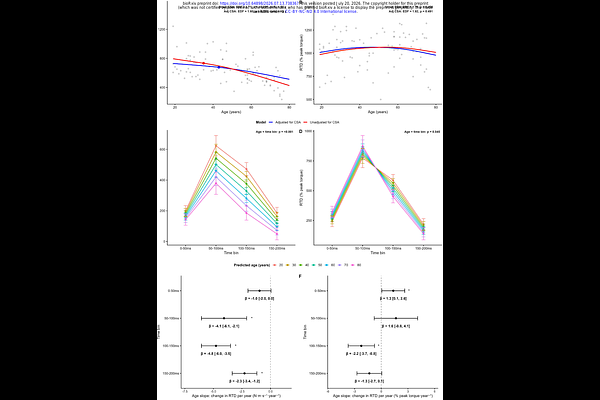
AbstractBackground: Dynamic power declines earlier across the lifespan and shows a more pronounced and complex pattern than isometric strength, particularly in ageing females. However, the functional, skeletal muscle and molecular mechanisms underpinning power loss across the female lifespan remain to be collectively examined. Methods: Eighty-six females aged 18-80 years and stratified per decade of age completed a series of maximal voluntary knee extensions to construct torque-velocity and power-velocity relationships of the quadriceps. Data points corresponding to >95% maximal power were selected for the evaluation of rate of torque development (RTD) and quadriceps surface electromyography (EMG). Outcomes were quantified within discrete 50ms time bins from torque onset to +200ms and included absolute RTD, RTD normalised to peak force, and EMG amplitude and rate of rise normalised to the maximal compound action potential. Quadriceps morphology was assessed via computed tomography, and a vastus lateralis muscle biopsy was collected to assess markers of denervation and expression of genes associated with the neuromuscular junction and calcium-handling transcriptome. Results: Ageing led to linear reductions in maximal power (-1.39 +- 0.01% p/year), torque (-0.98 +- 0.13% p/year) and velocity (-0.38 +- 0.01% p/year) (all p < 0.05). Quadriceps skeletal muscle CSA attenuated power loss by ~40% (p < 0.001), largely through reduction of the decline in torque (~50%), with no effect on the decline in velocity. During early time bins, older females generated higher relative RTD accompanied by higher EMG amplitude, whereas during later time bins, older females generated less absolute and relative RTD accompanied by lower EMG amplitude and rate of rise (all p < 0.05). Ageing increased neural cell adhesion molecule (NCAM) positive fibres and fibrosis (both p < 0.05). The presence of NCAM+; fibres was associated with attenuation of the age-related decline in maximal power (~15%), torque (~35%) and velocity (~60%), suggesting that NCAM+; fibre prevalence may partially explain the observed age associations. Within the neuromuscular junction transcriptome, ageing reduced acetylcholinesterase and increased laminin alpha-2 and muscle-specific kinase (all FDR < 0.05), whereas lesser changes were observed within the calcium-handling transcriptome. Conclusions: Skeletal muscle CSA explains ~40% of the age-related decline in quadriceps dynamic maximal power across the female lifespan, whereas a neurodegenerative profile mainly evidenced by age-related changes in voluntary neural drive, denervation and markers of neuromuscular junction instability further contribute to the decline.