Monotremes provide novel insights into evolution of the DMRT gene family in vertebrates

Monotremes provide novel insights into evolution of the DMRT gene family in vertebrates
van der Ploeg, R.; Shearwin-Whyatt, L.; Grutzner, F.
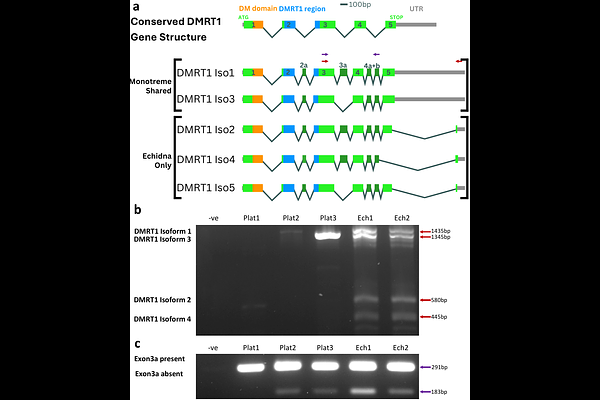
AbstractDoublesex and mab-3 related (DMRT) genes encode a family of transcription factors central to sexual development across metazoa. DMRT genes are characterised by a highly conserved DNA binding domain (DM) while flanking regions may vary between species. Gene duplication and loss has shaped the diversity of the DMRT genes with several unresolved questions about their evolution. The most well characterised and conserved DMRT gene, DMRT1, functions as a sexual regulator universally in metazoans. In chicken, DMRT1 is located on the Z chromosome and acts as a dosage dependent primary sex determination gene. In therian mammals DMRT1 is autosomal, however, two copies are required for male development. Interestingly in the basal lineage of egg-laying mammals (monotremes), DMRT1 is localised on the X specific part of one of the X chromosomes. This provided the first evidence of a sex chromosome system with homology to the avian Z chromosome and raises questions about the function and evolution of DMRT1 in egg-laying mammals. To gain insight into the evolution of mammalian DMRT genes we performed sequence and expression analysis of monotreme DMRT genes and comparative analysis with other vertebrates. In monotremes, we identified DMRT genes 1-7, and show that DMRT8 is absent, suggesting that DMRT8 evolved in therian mammals after the divergence of monotremes. Sequence and expression analysis revealed multiple monotreme specific DMRT1 isoforms with additional protein-coding exons. The independent evolution of monotreme specific changes in DMRT1 may be the first indication of functional or regulatory differences in monotreme DMRT1.