Functional connectome harmonics and dynamic connectivity maps of the preadolescent brain

Functional connectome harmonics and dynamic connectivity maps of the preadolescent brain
Mariani Wigley, I. L. C.; Berto, A.; Suuronen, I.; Jolly, A.; Li, R.; Merisaari, H.; Pulli, E. P.; Rosberg, A.; Audah, H. K.; Barron, A.; Luotonen, S.; Pastore, M.; Veronese, M.; Karlsson, H.; Korja, R.; Karlsson, L.; Cabral, J. R. B.; Kringelbach, M. L.; Atasoy, S.; Seidlitz, J.; Betlehem, R. A.; Tuulari, J. J.
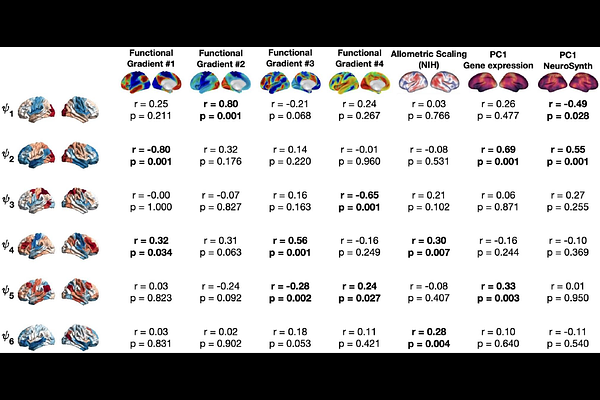
AbstractThe maturation of large-scale functional brain networks during preadolescence underpins critical cognitive and behavioral development. However, the spatial and temporal organization of these networks in this age group remains incompletely characterized. Here we applied Functional Connectome Harmonics (FCH) and Leading Eigenvector Dynamics Analysis (LEiDA) to resting-state fMRI data from over 11,000 children aged 9-10 years in the ABCD Study. FCH revealed hierarchical spatial gradients spanning cortical and subcortical regions, while LEiDA identified recurrent dynamic brain states aligned with canonical intrinsic connectivity networks. Linking these spatial and temporal components, we established a low-dimensional harmonic scaffold constraining brain dynamics during this developmental window. These findings provide a large-scale spatiotemporal reference framework of preadolescent functional brain organization, offering a foundation for characterizing neurodevelopmental benchmarks and early neural markers relevant to adolescent mental health.