Oxytocin mediates the acquisition and strategy formation of cooperation in rats

Oxytocin mediates the acquisition and strategy formation of cooperation in rats
Lin, Y.; Wei, L.; Wang, Q.; Wang, Z.
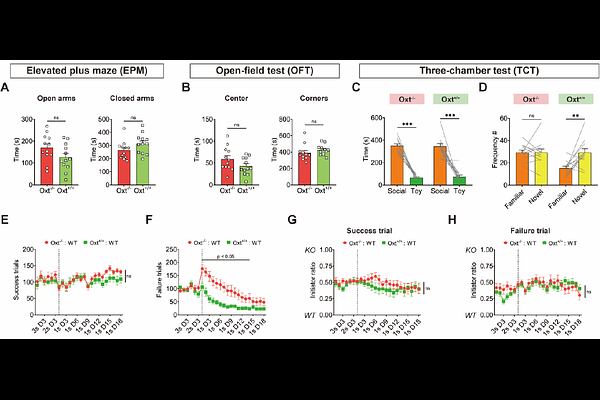
AbstractCooperative behaviors are widespread in nature and play fundamental roles throughout animal lifespans. However, the learning processes and strategy formation underlying cooperation remain largely unknown. Oxytocin (OXT) is a neuropeptide that regulates both social and non-social behaviors, yet its roles in modulating cooperative behaviors remain to be fully elucidated. To investigate these questions, we developed a temporal coordination-based cooperative paradigm for rats and manipulated the OXT system during training. Through progressive cooperative training, rats acquired cooperation and efficiently performed the task via social interaction. This learning process was accompanied by increased OXT release in social learning-associated brain regions, whereas OXT knockout impaired learning speed. Furthermore, rats displayed different cooperative strategies, with the communication-based strategy gradually increasing and becoming predominant during the cooperative training. Both OXT knockout and inhibition of OXT-ergic neurons in the paraventricular nucleus (PVN) of the hypothalamus during learning reduced the adoption of communication-based strategy. Together, our results demonstrate that OXT is necessary for both the acquisition and the strategy formation of cooperation in rats, thereby facilitating mutual rewards. These findings provide new insights into the neural mechanisms by which OXT regulates social behaviors and offer potential therapeutic implications for neuropsychiatric disorders involving social deficits, such as autism spectrum disorder and social anxiety disorder.