Towards Mesoscopic Human Brain Imaging Using Non-Parametric Diffusion Tensor Distribution (DTD) MRI

Towards Mesoscopic Human Brain Imaging Using Non-Parametric Diffusion Tensor Distribution (DTD) MRI
Magdoom, K. N.; Sarlls, J. E.; Basser, P.
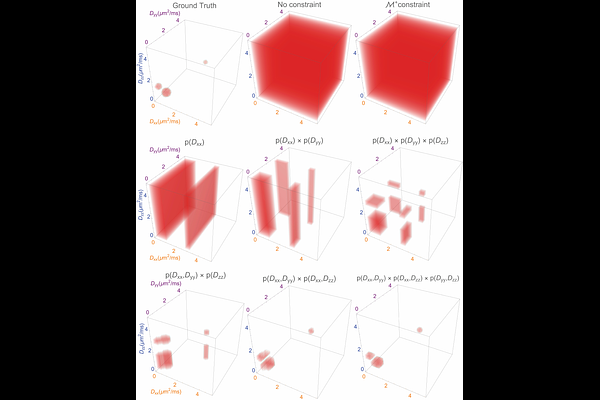
AbstractThe majority of MR-based brain imaging methods provides macroscopic information averaged over the entire imaging voxel. Yet tissue composition and microstructure are heterogeneous within the cubic millimeter-sized MRI voxel that contains numerous distinct water pools at mesoscopic, microscopic, and nanoscopic length scales. Accurately measuring their individual characteristics in live human brain has the potential to reveal hidden salient meso/microstructural features and uncover subtle changes that may occur in development, neurological disorders, trauma, etc. Nevertheless, because of many technical and scientific challenges, there is a dearth of robust, quantitative methods to probe tissue water dynamics at these subvoxel length scales. Here we present a novel empirical spectroscopic diffusion MRI method that estimates the probability density function (pdf) of diffusion tensors, i.e., the diffusion tensor distribution (DTD) in the human brain in-vivo. Our method entails performing a multi-dimensional Inverse Laplace Transform (ILT) which is generally an ill-posed and ill-conditioned problem. However, we overcome these obstacles using a hierarchy of lower-dimensional marginal distributions of the DTD estimated from diffusion weighted (DW) signals obtained from single, double, and triple pulsed-field gradient (PFG) experiments. Iteratively applying this hierarchy of marginal distribution progressively shrinks the space of admissible solutions. We extensively vet this framework with simulated DWI data obtained from realistic DTD motifs that mimic different cell and tissue properties seen in the brain. We then experimentally test our approach in vivo in brains of healthy normal human subjects. We segment the reconstructed DTD within a voxel to identify signatures of different tissue and cell types, and cluster these DTDs to identify various water pools. We use the high dimensional spectrum to robustly remove the free water compartment that often confounds tissue microstructure. We take ensemble averages of invariants of the micro-diffusion tensors, and measure and map their distributions to visualize salient intrinsic mesoscopic features. Since DTD MRI subsumes DTI, we also compute the family of DTI-derived quantitative imaging biomarkers from the moments of the distributions of the mean diffusivity and FA derived from the DTD. Our approach has great translational potential, revealing new microstructural features not observed previously observed in in vivo MRI.