Shared QTLs underlie loss of a conserved trait in replicate mapping populations of Arabidopsis thaliana

Shared QTLs underlie loss of a conserved trait in replicate mapping populations of Arabidopsis thaliana
Plunkert, M.; Issaka Salia, O.; Woolcock, E.; Perez, S.; Conner, J. K.
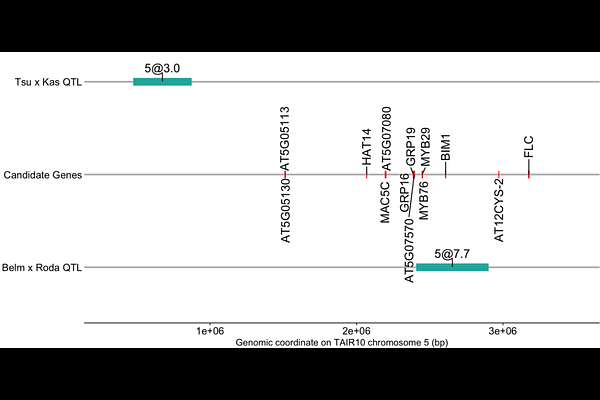
AbstractThe evolutionary mechanisms leading to nonfunctional trait loss are not well understood. Some Arabidopsis thaliana populations display incomplete loss of short stamens, floral organs that do not contribute significantly to seed set in this species. In nature, short stamen number is correlated with ovule number and flowering time, suggesting that pleiotropy with these traits could drive stamen number evolution. To investigate the role of pleiotropy in short stamen number evolution, we performed QTL mapping of stamen number and ovule number and examined previously published QTL analyses of flowering time for two sets of RILs, Belm-12 x Roda-47 and Tsu-1 x Kas-1. Flowering time, ovule number, and short stamen loss were correlated in Belm-12 x Roda-47 RILs, but not Tsu-1 x Kas-1 RILs. For both stamen and ovule number, some QTLs were unique to each RIL set and others were shared. Notably, for Belm-12 x Roda-47 RILs, we mapped QTLs affecting ovule and short stamen number to a region of chromosome 5 that also affects flowering time. For Tsu-1 x Kas-1 RILs, we identified the same chromosome 5 region as a short stamen number QTL, but ovule number and flowering time QTLs map to other genomic regions. While some genetic architectures of short stamen number and traits that are correlated in nature suggest linked or pleiotropic loci on chromosome 5, other architectures allow for recombination between QTLs that affect stamen number, ovule number, and flowering time. The role of pleiotropy in short stamen number evolution is therefore context dependent.