Tissue-specific chromatin accessibility and co-factor availability together define ASCL1-dependent neural reprogrammability across germ layers during embryogenesis

Tissue-specific chromatin accessibility and co-factor availability together define ASCL1-dependent neural reprogrammability across germ layers during embryogenesis
Lando, D.; Kausar, S.; Shigeoka, T.; Connor, F.; Jullien, J.; Philpott, A.
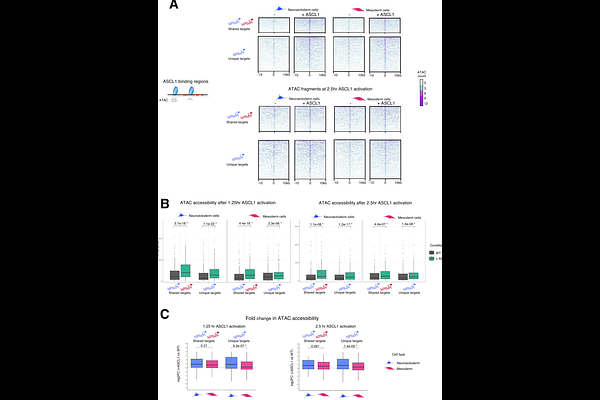
AbstractThe proneural transcription factor ASCL1 is well established as a pioneering neuronal reprogramming factor in several contexts. However, the extent to which distinct tissue types adopt a similar or divergent response to the same ASCL1 fate challenge is unclear. By expressing ASCL1 across germ layers and tissues of the developing Xenopus neurula embryo, we reveal widespread but largely distinct transcriptomic and chromatin responses to ASCL1. Ectopic ASCL1 can access partially open chromatin sites across all tissues, but it is able to further open those sites specifically in neuroectoderm. Using motif enrichment and accessibility analyses we identify Sox transcription factor motifs as enriched and preferentially accessible at ASCL1-bound regions in neuroectoderm. We show that co-expression of Sox3 and ASCL1 can enable the activation of otherwise refractory ASCL1 target genes in mesoderm and epidermal skin. Our findings reveal how the chromatin landscape and co-factor availability work together to modulate the response to transcription factor-driven fate challenge during development.