Psilocybin asymmetrically modulates outcome-based choice and cortical processing under uncertainty

Psilocybin asymmetrically modulates outcome-based choice and cortical processing under uncertainty
Jacobs, D. S.; Pacheco, A. T.; Olson, R.; Langdon, A. J.; Moghaddam, B.
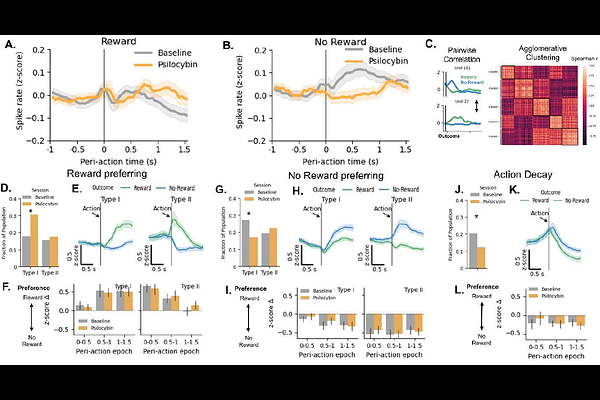
AbstractEmerging clinical research with psilocybin highlights the value of the psychedelic experience on successful treatment of a multitude of psychiatric disorders. While the psychedelic trip or clinical support procedures cannot be modeled in rodents, neural processes critical to meta-learning and flexible modification of previously learned strategies can be quantified during psilocybin exposure. Here we applied computational modeling and single unit recordings from medial prefrontal cortex to characterize the effect of psilocybin using a value-based probabilistic choice task. Psilocybin improved choice selection in uncertain contexts and shifted reinforcement learning rate bidirectionally, enhancing updating from rewarded, while reducing updating from unrewarded, actions. These behavioral changes coincided with selective shifts in the neural encoding of task features including enhanced neural representation of rewarded, and diminished representation of unrewarded, outcomes. Collectively these data indicate that psilocybin improves choice selection in uncertain contexts by reweighing cortical coding in a way that favors learning from positive new information over prospective actions.