Phasic Neural Stimulation via Frequency-Modulated Kilohertz Signals: An Alternative to Amplitude Modulation

Phasic Neural Stimulation via Frequency-Modulated Kilohertz Signals: An Alternative to Amplitude Modulation
Rose, D. S.; Opancar, A.; Zelnicek, S.; Sromova, V.; Glowacki, E. D.
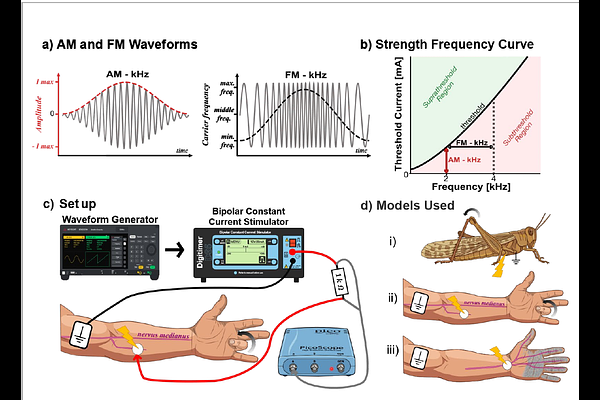
AbstractKilohertz-frequency (kHz) electrical stimulation (1-100 kHz) is emerging as a powerful tool in both invasive and non-invasive neurostimulation applications, including functional electrical stimulation, spinal cord stimulation, and non-invasive brain stimulation. Most commonly these paradigms rely on amplitude modulation (AM kHz), achieved via burst or sinusoidal modulation, to produce phasic neural activation. Here, we propose, and validate, an alternative: frequency-modulated kilohertz stimulation (FM kHz). This approach leverages the distinct strength-frequency dependence of kHz signals, whereby higher carrier frequencies are less efficient in depolarizing neurons than lower frequencies. By sweeping between sub- and suprathreshold frequencies, at a constant amplitude, FM kHz generates a phasic neural activation envelope analogous to AM kHz, without requiring amplitude modulation. Using both computational modelling and experimental data from Locusta migratoria (N5 nerve) and the human median nerve, we demonstrate that FM kHz stimulation: 1. Produces reliable phasic evoked responses at the FM frequency; 2. Enables two degrees of control over stimulation, via FM frequency and frequency deviation. Across models tested, FM kHz thresholds followed the same increasing strength-frequency relationship as AM kHz, with FM kHz requiring modestly higher thresholds at the upper end of the tested frequency range. These findings position FM kHz as a viable and potentially advantageous alternative to AM kHz strategies for future neuromodulation devices, and conceptually ground strength-frequency dependence as the key parameter in interpreting the effects of kHz electrical stimulation.