Combining Stability-Centered Atomistic Design with Machine Learning for Targeted Enzyme Optimization

Combining Stability-Centered Atomistic Design with Machine Learning for Targeted Enzyme Optimization
Wan, L.; Bagherpoor Helabad, M.; Fraedrich, L.; Fleishman, S. J.; Weissenborn, M.
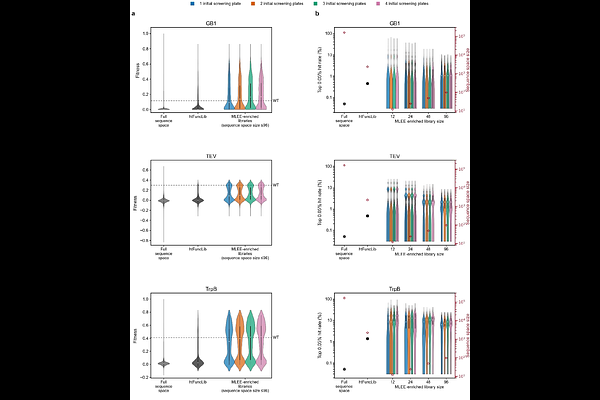
AbstractFuncLib and high-throughput FuncLib (htFuncLib) generate diverse, functional protein libraries using a stability-centered design; however, this substrate-independent approach lacks target-specific functional constraints. We developed a machine-learning-assisted enzyme-engineering (MLEE) workflow that adds substrate-specific functional information to htFuncLib through an initial screening and sequencing round. The system was benchmarked using previously published four-position fitness landscapes of three different proteins. The MLEE workflow successfully generated compact libraries enriched in globally high-fitness variants. After the initial training phase, an MLEE-enriched library of just 12 variants increased the hit rate for the global top-0.05% variants by 5- to 12-fold relative to the htFuncLib baseline. Screening a larger set of 96 variants recovered at least one of these top-performing enzymes in 61.3-99.4% of the simulations. We then applied MLEE to MthUPO-catalyzed beta-damascone hydroxylation. Across two rounds, 506 distinct variants were screened and sequenced. While the initial substrate-independent htFuncLib library yielded 14% of variants with activity above the wild type, the MLEE-enriched library increased this hit rate to 90% (97 of 108 variants) with activity above the wild type. The best variant increased the turnover number for 4-hydroxy-beta-damascone by 11.8-fold and achieved >99% regioisomeric excess. MLEE therefore converts sequence spaces designed for stability into substrate-specific libraries suited to low- and medium-throughput screening without requiring a predefined productive substrate pose.