Bacteria-mimetic bioadhesives with multivalent mucoadhesion and drug-compatible delivery

Bacteria-mimetic bioadhesives with multivalent mucoadhesion and drug-compatible delivery
Hohnston, E.; Farrow, M.; Yang, Z.; Bahmani, A.; Liu, Y.; Huang, X.; Yan, J.; Li, J.
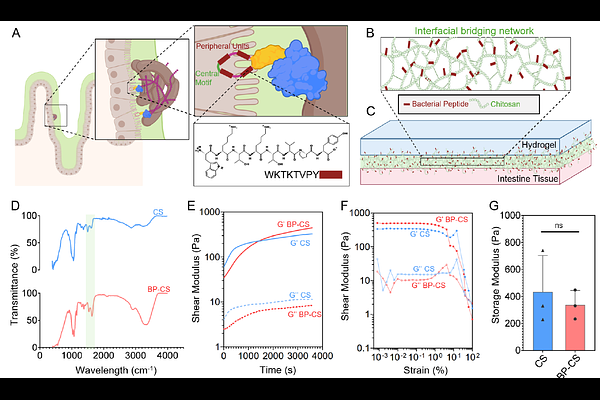
AbstractThe ability to adhere to mucus-lined tissues underpins a range of biomedical devices and therapies. However, many existing strategies rely on covalent bonding chemistries and can be unstable, cytotoxic, or incompatible with therapeutics. Here, we present a bacteria-mimetic bioadhesion strategy inspired by Vibrio cholerae. A short Bap1-derived adhesion peptide is grafted onto chitosan to strengthen mucus interactions through multivalent, cooperative secondary bonding, while preserving pH-triggered interfacial bridging behavior. Bacterial peptide grafting significantly increases adhesion energy on porcine intestine, and when paired with a tough hydrogel matrix achieves adhesion energies >400 J/m^2 without forming covalent bonds to tissue. Confocal imaging reveals deep tissue penetration (~80 m) with markedly enhanced mucin binding and no loss of cytocompatibility. Ex vivo intestinal delivery and in vitro drug release tests demonstrate improved drug transport and tissue exposure compared to carbodiimide-mediated covalent bonding strategy. These findings establish a bacteria-mimetic bioadhesion strategy for tissue repair and drug delivery. Novelty Statement: Bioadhesive designs have drawn inspiration from nature such as mussel-inspired catechol chemistry and gecko-inspired dry adhesion. In contrast, bacterial adhesion mechanisms, despite enabling robust colonization of mucus-lined tissues under demanding conditions, remain largely overlooked. This work introduces a bacteria-mimetic bioadhesion strategy that selectively repurposes a short, non-pathogenic peptide derived from a Vibrio cholerae adhesin to enhance bioadhesion through multivalent, cooperative physical interactions rather than covalent bonding. This strategy significantly toughens adhesion even on chitosan, a polymer already rich in adhesive functional groups. By decoupling bacterial adhesion function from pathogenic risk, this study establishes bacterial adhesion peptides as a safe, modular, and mechanistically distinct foundation for next generation bioadhesives with improved drug compatibility.