Single-kernel near-infrared spectroscopy enables haploid kernel sorting in field and sweet corn using high-oil haploid inducers across diverse donor-inducer combinations

Single-kernel near-infrared spectroscopy enables haploid kernel sorting in field and sweet corn using high-oil haploid inducers across diverse donor-inducer combinations
Sharma, S.; Gustin, J. L.; Frei, U. K.; Settles, A. M.; Lübberstedt, T.; Resende, M. F. R.; Hershberger, J.
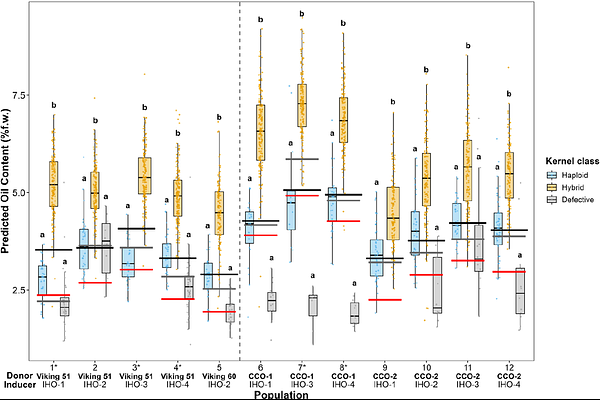
AbstractDoubled haploid (DH) technology significantly shortens the breeding cycle for developing homozygous inbred lines in maize (Zea mays). Manual sorting of haploids from a larger bulk of hybrid kernels in an induction cross is a major bottleneck in DH development. Automated systems based on near-infrared (NIR) reflectance spectroscopy can be valuable tools for rapid haploid sorting, provided that sorting accuracy is sufficient for incorporation into the DH process. In this study, we evaluated the accuracy of a custom-built single-kernel NIR (skNIR) sorter for classifying haploid kernels from 12 high-oil haploid induction populations generated from two sweet corn and two field corn donors and four high-oil haploid inducers (HOHIs). We evaluated several general classification models that can be applied without population-specific recalibration or prior genotyping, including models that classified haploids based solely on predicted oil content, as well as multivariate methods that used all wavelengths of the NIR spectra. The highest classification accuracy was obtained using a general multivariate support vector machine (SVM) model. When combined with the two best-performing HOHIs, the general SVM model accurately sorted induction populations from two of the three donor backgrounds crossed with these inducers. Two oil-based methods showed less accurate classification than the multivariate SVM model, due to overlapping oil content distributions across the two kernel classes. Overall, this study demonstrates effective skNIR-based sorting of haploid kernels from diverse induction populations using a single general model. The practical deployment of this instrument in maize breeding programs is discussed.