Under pressure: Evolutionary trade-offs shape the single visual opsin of deep-sea octopods

Under pressure: Evolutionary trade-offs shape the single visual opsin of deep-sea octopods
De Vivo, G.; Ma, M.; Forni, G.; Luchetti, A.; Crocetta, F.; Lienard, M. A.; D'Aniello, S.
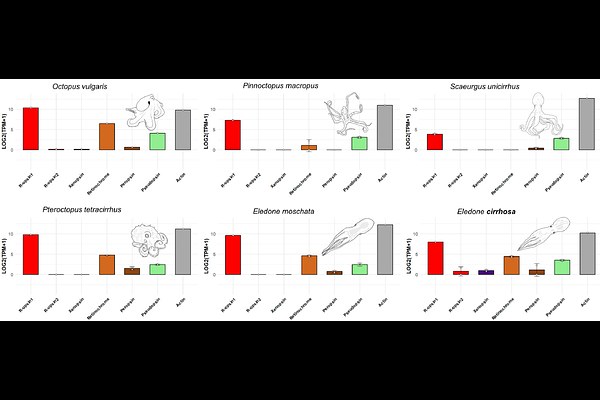
AbstractOctopods possess remarkable camera-type eyes and specialised image-forming vision that support orientation, prey detection, predator avoidance and visual communication. Unlike vertebrates and arthropods, however, octopod vision is thought to rely mainly on a single rhodopsin (r-opsin1), raising the question of how such a constrained system adapts across contrasting light environments from shallow coastal waters to deep-sea habitats. Using transcriptional profiling of the retina and optic lobe from seven native octopod species of the Gulf of Naples, we show that r-opsin1 is the predominant visual gene across all species and investigate how contrasting photic habitats have shaped its molecular and functional evolution. Although positive selection analyses revealed no general association between habitat depth and r-opsin1 evolution, twelve codons in the deep-mesopelagic Pteroctopus tetracirrhus r-opsin1 showed evidence of positive selection, including two residues located on opposing helices of the retinal-binding pocket. In vitro experiments demonstrated that substituting either I87V and F201N produced a marked bathochromatic shift from the wild-type blue-green spectrum towards red wavelengths, whereas their combination restored the wild-type spectral profile. Other deep-sea octopod r-opsin1 naturally bearing one of these substitutions retained blue-green sensitivity. Reconstructed ancestral proteins similarly maintained blue-green absorption, supporting conservation of this spectral phenotype throughout octopod r-opsin1 evolution. We further show that F201N reduces adiabatic compressibility within the retinal-binding pocket, by co-evolving compensatory sites offering a structural trade-off, favouring pressure adaptation while restraining spectral tuning. Together, our findings support that octopod visual rhodopsin evolution has been shaped by the multiple ecological pressures of contrasting marine environments, illustrated with lineage-specific and habitat-dependent trajectories on a single locus while preserving a conserved visual phenotype.