Distinct Glutamatergic Inputs to the Nucleus Accumbens Differentially Regulate Vulnerability to Cannabinoid Addiction

Distinct Glutamatergic Inputs to the Nucleus Accumbens Differentially Regulate Vulnerability to Cannabinoid Addiction
Ponce-Beti, F.; Gusinskaia, T.; Marin-Blasco, I.; Capellan, R.; Fronza, M. G.; Andero, R.; Maldonado, R.; Martin Garcia, E.
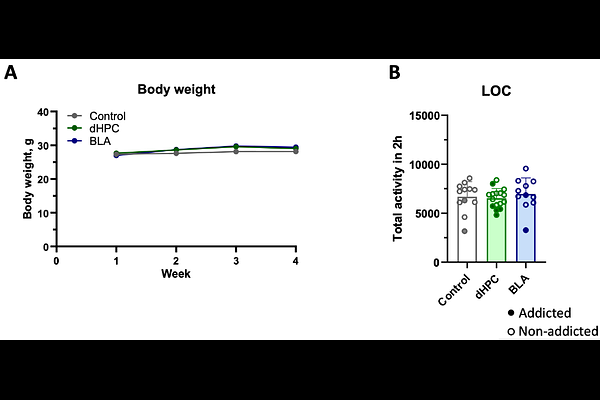
AbstractCannabis use disorder (CUD) is a chronic relapsing disorder characterized by compulsive drug seeking, persistent drug use despite adverse consequences, and a high risk of relapse. Although the nucleus accumbens (NAc) is a central hub in the neural circuitry underlying addiction, the specific glutamatergic inputs regulating vulnerability to cannabinoid addiction remain poorly understood. Here, we investigated the contribution of two major limbic glutamatergic projections to the NAc, the dorsal hippocampus (dHPC) to NAc and basolateral amygdala (BLA) to NAc pathways, using a validated mouse model of WIN55,212-2 intravenous self-administration combined with projection-specific chemogenetic inhibition. Male C57BL/6J mice received combinatorial viral vector delivery of inhibitory hM4Di DREADDs selectively targeting either the dHPC to NAc or the BLA to NAc pathway. Chronic pathway inhibition was achieved by continuous administration of deschloroclozapine through osmotic minipumps during the development of cannabinoid addiction-like behavior. Animals were evaluated using a multidimensional behavioral paradigm assessing the three-core addiction-like criteria of persistence of drug seeking, motivation, and compulsive-like behavior, as well as craving-related behaviors and phenotypic vulnerability traits. Chronic inhibition of either the dHPC to NAc or the BLA to NAc pathway significantly increased the proportion of mice developing an addiction-like phenotype. Both manipulations enhanced persistence of drug seeking during periods of drug unavailability, identifying persistence as a shared behavioral consequence of disrupting glutamatergic signaling to the NAc. In contrast, the two pathways differentially regulated other addiction-related behaviors. Inhibition of the dHPC to NAc pathway increased motivation to obtain WIN55,212-2, impulsivity, reward sensitivity, and resistance to extinction, whereas inhibition of the BLA to NAc pathway selectively enhanced cue-induced drug seeking. Neither manipulation altered compulsive-like responding, locomotor activity, or body weight. These findings demonstrate that distinct glutamatergic afferents to the NAc differentially regulate vulnerability to cannabinoid addiction-like behavior while converging on persistence as a common circuit-level mechanism. Our results establish the NAc as an integrative hub coordinating complementary contextual and emotional information during the transition to cannabinoid addiction and provide a circuit-based framework for understanding the neural mechanisms underlying Cannabis Use Disorder.