Glycocalyx-Directed Enzymatic Hydrogels Unlocks Fibroblast Regeneration to Promote Diabetic Wound Healing

Glycocalyx-Directed Enzymatic Hydrogels Unlocks Fibroblast Regeneration to Promote Diabetic Wound Healing
Ganesan, V.; Jahan, I.; Karmakar, A.; Raut, S.; Dutta, S.; Harazi, M. A.; Pandya, J.; Munshi, R.; Kumbhar, D.; Bhatt, l. K.; Sen, S.
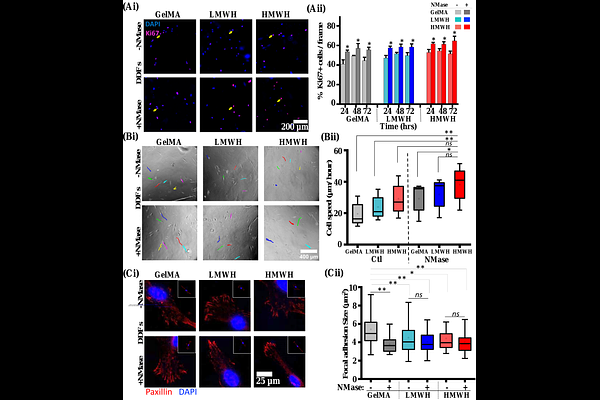
AbstractChronic diabetic wounds remain a major clinical challenge because current therapies address infection or supplement growth factors without correcting the cellular dysfunction that prevents regeneration. We identify pathological glycocalyx thickening in diabetic dermal fibroblasts (DDFs) as a driver of elevated caspase 3, 8, and 9 expression and heightened apoptosis - deficits that stall wound repair. Cleavage of sialic acid residues by neuraminidase (NMase) reverses this dysfunction, restoring fibroblast migration, proliferation, and contractility. We engineer a photo-crosslinked hybrid hydrogel combining methacrylated gelatin (GelMA) with high-molecular-weight methacrylated chitosan (HMW ChMA). ChMA increases storage modulus 8-12-fold, reduces pore size, and confers antibacterial activity against gram-positive and gram-negative bacteria, addressing infection susceptibility. The fortified HMW hybrid (HMWH) network enables sustained, localized NMase delivery that outperforms GelMA alone in resisting degradation and controlling release kinetics. NMase-loaded HMWH (N-HMWH) gels enhance DDF proliferation and migration in vitro, correlating with reduced focal adhesion size and increased turnover. In a diabetic rat model, N-HMWH patches achieve superior wound closure, outperforming EGF therapy, with robust epidermal regeneration, neovascularization, and collagen deposition. This work establishes glycocalyx-targeting hydrogels as a new class of wound therapeutics addressing the root cause of diabetic fibroblast failure, not just compensating with growth factors.