Trehalose-6-phosphate synthase promotes thermotolerance by governing glycolytic flux in Cryptococcus deneoformans

Trehalose-6-phosphate synthase promotes thermotolerance by governing glycolytic flux in Cryptococcus deneoformans
Yadav, V.; Carl, K. A.; Heitman, J.; Washington, E. J.
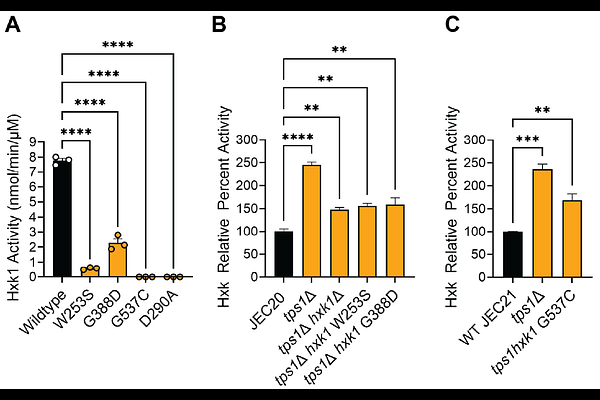
AbstractGrowth at physiologically relevant temperatures is essential for fungal pathogenesis and is controlled by several cellular factors. The evolution of fungal thermotolerance is concerning as warming environments may promote the emergence of new pathogens. Trehalose, a disaccharide absent in mammals, plays a central role in thermotolerance by stabilizing proteins and membranes during heat stress. Trehalose is synthesized from glucose-6-phosphate (G6P) and uridine-diphosphate-glucose (UDPG) in two steps catalyzed by trehalose-6-phosphate synthase (Tps1) and trehalose-6-phosphate phosphatase (Tps2). Here, we investigated genetic suppression of Tps1 function in Cryptococcus deneoformans, a species in the Cryptococcus pathogenic species complex. Tps1 is essential for growth at 37{degrees}C in C. deneoformans and spontaneous suppressor mutations restored the growth of tps1{Delta} mutants at 37{degrees}C. Whole-genome sequencing followed by variant calling analysis primarily identified loss-of-function mutations in the gene encoding hexokinase 1 (Hxk1). Targeted gene deletion mutants further showed that loss of either HXK1 or HXK2 can bypass tps1{Delta} in a carbon source-dependent manner. The tps1{Delta} mutant exhibited elevated hexokinase activity, accumulation of G6P and glycogen, and ATP depletion after heat shock. Deletion of HXK1 or HXK2 restored hexokinase activity and partially restored G6P and ATP levels in the tps1{Delta} mutant, while glycogen remained elevated, indicating that excess glycolytic flux underlies the tps1{Delta} high-temperature growth defect. Overall, our study uncovers a previously unappreciated mechanism of Tps1-mediated heat adaptation in C. deneoformans, by revealing that Tps1 functions as a critical metabolic gatekeeper that safeguards glycolytic flux to sustain growth at elevated temperatures.