Birds protected in Europe, overlooked in Africa: conservation synergies between African primates and wintering Afro-Palearctic migratory birds

Birds protected in Europe, overlooked in Africa: conservation synergies between African primates and wintering Afro-Palearctic migratory birds
Kiribou, I. A. R.; Mucyo, J. P. S.; Kazaba, P. K.; Kamga, S. M.; Kuehl, H. S.; Junker, J.; Sasse, T.; Heinicke, S.
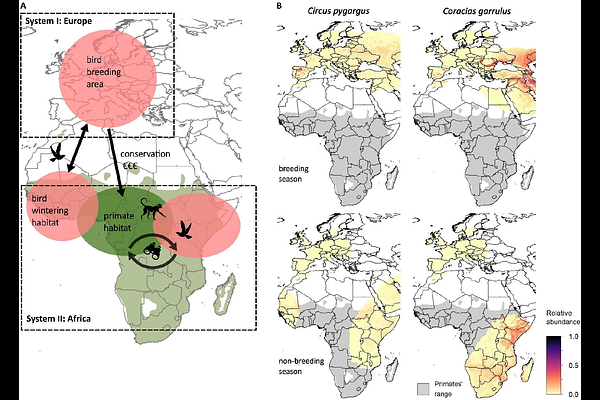
AbstractPrimates are frequent targets of international conservation efforts, due to their anthropological significance and function as biodiversity conservation flagship species. Afro-Palearctic migratory birds receive considerable conservation attention in their breeding habitats, but much less in their wintering areas. Good wintering habitat conditions are, however, crucial for long-term population viability. Integrating complementary conservation efforts for these taxa may provide substantial co-benefits. Here, we evaluate the spatial, ecological, and conservation congruence between 248 Afro-Palearctic migratory bird and 213 African primate species to identify potential synergies in intercontinental conservation efforts. The wintering areas of 218 migratory bird species overlap with primate ranges. Up to 125 Afro-Palearctic migratory bird species co-occur with at least one primate species locally and highest regional cross-taxon richness occurs in forest-savanna ecotones in West Africa and eastern DRC. Agriculture and hunting threaten both taxa (88-97% of primate and 59-70% of bird species). Several conservation interventions have demonstrated effectiveness for both taxa, particularly habitat protection and hunting reduction. We propose three policy priorities: strengthening cross-taxa monitoring within existing primate research infrastructure, improving the conservation evidence base in the African context, and creating financing synergies that allow conservation investments to simultaneously benefit both taxa.