Serine proteases are required to activate influenza D virus haemagglutinin-esterase fusion (HEF) protein

Serine proteases are required to activate influenza D virus haemagglutinin-esterase fusion (HEF) protein
Maina, M.; Zhang, J.; Mayora Neto, M.; da Costa, K. A.; Bottcher-Friebertshauser, E.; Hutchinson, E.; Marotta, M. G.; Trombetta, C.; Scott, S. D.; Temperton, N. J.; Daly, J. M.
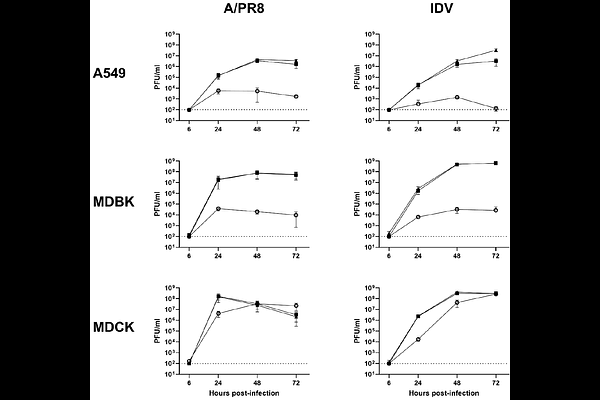
AbstractInfluenza D virus (IDV), the most recently identified member of the Orthomyxoviridae, was first isolated from pigs but cattle have been identified as the reservoir host. To date, IDV has not been confirmed to cause human disease. Like the haemagglutinin (HA) of influenza A virus (IAV) and the haemagglutinin-esterase fusion (HEF) protein of influenza C virus (ICV), the IDV HEF is produced as a precursor protein (HEF0) that must be proteolytically cleaved by host cell proteases (into HEF1 and HEF2) to gain its fusion capacity. The proteases that activate IAV HA have been extensively studied, but those responsible for activation of IDV HEF were unknown. Identifying these proteases is key to understanding early virus-host interactions and host restriction. Therefore, we generated ICV and IDV pseudotyped viruses (PVs) in HEK 293T producer cells with or without co-transfection of plasmids expressing different type II serine proteases. Subsequent transduction of swine testicular (ST) cells indicated strong activation of both ICV and IDV PVs by the human airway trypsin-like protease (HAT) and its swine homologue (swAT). Furthermore, like influenza A/Puerto Rico/8/34 (H1N1) virus, addition of exogenous protease is not essential for IDV replication in MDCK II cells, most likely due to endogenous expression of matriptase. In conclusion, our data unveil new information on host cell proteases that activate ICV and IDV HEF proteins. Importantly, the data suggest that protease specificity is not a factor in restriction of IDV replication in the human upper respiratory tract.