Geographic structuring of genetic variation differs across two contact zones in the Diglossa carbonaria superspecies

Geographic structuring of genetic variation differs across two contact zones in the Diglossa carbonaria superspecies
Hiller, A. E.; Faircloth, B. C.; Brumfield, R. T.
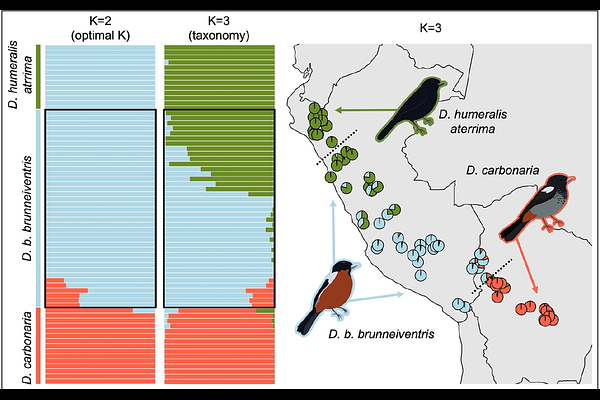
AbstractRapid radiations, where species quickly diversify with little to no change in the genetic composition of the taxa, provide unique opportunities to understand the processes underlying lineage divergence, especially when the newly formed species come into contact. This study examines three parapatrically distributed taxa of the Andean Diglossa carbonaria superspecies that differ strikingly in plumage and have been classified as an example of rapid lineage divergence. Using RADSeq data, we characterized the geographic structuring of genetic variation and investigated the possibility of introgressive hybridization at the contact zones between D. humeralis atterima and D. b. brunneiventris in northern Peru and between D. b. brunneiventris and D. carbonaria in Bolivia. We found weak genetic differentiation between D. humeralis atterima and D. b. brunneiventris and low, but diagnosable, differentiation between D. b. brunneiventris and D. carbonaria. At the contact zone between D. humeralis atterima and D. b. brunneiventris, the lack of genetic differentiation did not allow us to determine if hybridization was occurring between the taxa. In contrast, clustering analyses, diagnostic allele identification, and PCA analyses showed geographic patterns consistent with introgressive hybridization at the contact zone between D. b. brunneiventris and D. carbonaria, a geographic region where birds that are intermediate in plumage have been observed. Finally, we found a genetic break within the distribution of D. b. brunneiventris. The genetic divergence across this ~450 km wide break is greater than that found between D. humeralis atterima and D. b. brunneiventris. Our results add to previous work documenting weak genetic differentiation between taxa that have striking plumage differences, and in showing that plumage color may be a poor phylogenetic marker.