Expanding the repertoire of suicidal germination stimulants for control of parasitic weeds

Expanding the repertoire of suicidal germination stimulants for control of parasitic weeds
Mave, G. D.; Musyoka, T. M.; Mutinda, S.; Mutindi, F.; Kibet, W.; Toili, M. E. M.; Muiruri, S.; Onguso, J.; Tripathi, J.; Tripathi, L.; Runo, S.
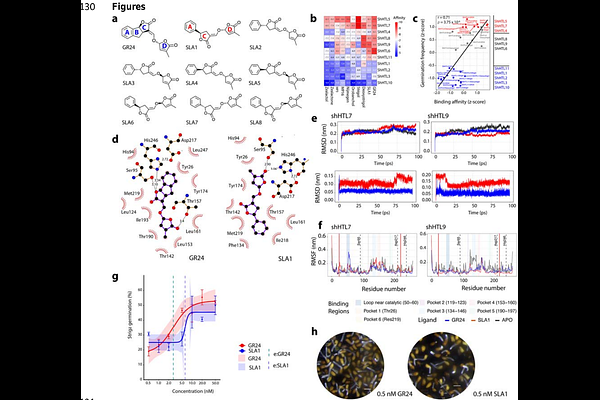
AbstractWitchweeds (Striga spp.) are parasitic plants that severely constrain cereal production across sub Saharan Africa, threatening food security for millions of people (Runo and Kuria, 2018). Striga infection begins when dormant seeds germinate in response to host derived biomolecules, primarily strigolactones which plants emit to regulate shoot branching and to communicate with beneficial microbes. This obligate dependence on host signals can be exploited for Striga control through suicidal germination, whereby strigolactone like compounds induce parasite germination in the absence of a host. Although this strategy proved highly effective during Striga eradication efforts in the United States using ethylene gas as a Striga germination inducer (Eplee, 1975; Iverson et al., 2011), its deployment in Africa has been limited by capacity to synthesize cost effective strigolactone like Striga germination inducers. Here, we show that structure guided in silico screening of chemical libraries using AlphaFold2 modeled receptor ligand interactions improve the efficiency and likelihood of identifying previously unknown strigolactone analogs. Using this approach, we identify a structurally simple synthetic lactone scaffold that induces Striga germination at nanomolar concentrations. These results present new avenues for the development of strigolactone analogs and support revisiting suicidal germination as a practical Striga control strategy in Africa.