Adaptive immunity is dispensable for appendage regeneration in highly regenerative vertebrates

Adaptive immunity is dispensable for appendage regeneration in highly regenerative vertebrates
Bolanos Castro, L. A.; Valappil, Y. O.; Petzold, A.; Knopf, F.; Yun, M. H.
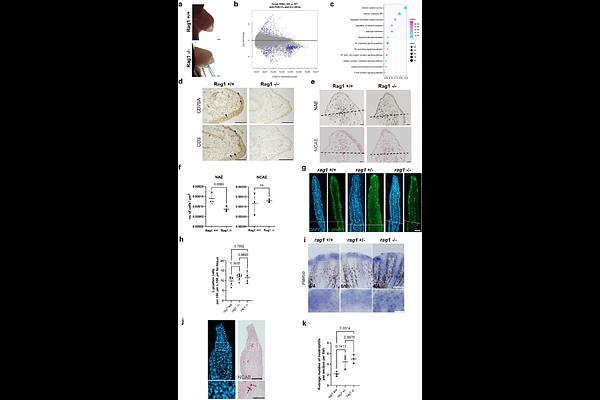
AbstractAdaptive immunity has been implicated in tissue repair and homeostasis, however its requirement for complex appendage regeneration in adult vertebrates remains unknown. Here, we show that adaptive immune components are dynamically recruited to regenerating appendages. Using genetic lymphocyte ablation in highly regenerative vertebrates, axolotl (Ambystoma mexicanum) and zebrafish (Danio rerio), we show that mature T and B cells are dispensable for limb, tail and fin regeneration in sexually mature animals. Despite depletion of peripheral and lymphoid T and B populations, Rag1-/- axolotls and zebrafish regenerate appendages with normal kinetics, patterning, and skeletal outcomes. Rag1 -/- regenerating blastemas undergo transcriptomic remodelling including alterations in innate immune genes accompanied by increased neutrophil/myeloid infiltration, highlighting innate immunity as a potential compensatory element for regenerative success. Together, these results indicate that adaptive immunity is not required for restoration of complex appendages in vertebrates, a finding of basic and translational relevance.