Genetic dissection of root-mediated yield heterosis in melon (Cucumis melo)

Genetic dissection of root-mediated yield heterosis in melon (Cucumis melo)
Dafna, A.; Tzuri, G.; Oren, E.; Isaacson, T.; Halperin, I.; Peleg, G.; Gur, A.
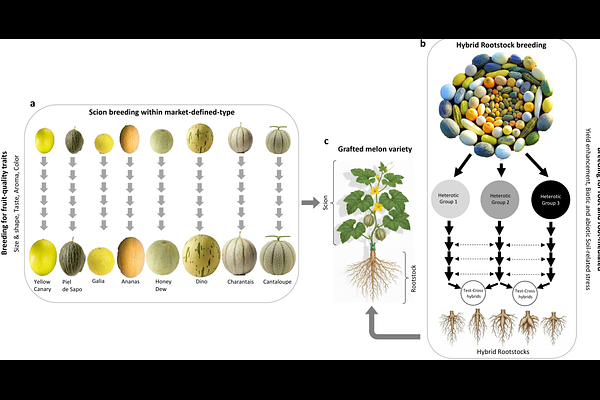
AbstractHeterosis, the superiority of hybrids over their parents, is a major genetic force associated with plant fitness and crop yield enhancement. We previously discovered and characterized root-mediated yield heterosis (RMYH) in melon (Cucumis melo) using a half-diallel population, derived from 20 diverse parents. In the current study we investigated the genetic architecture of RMYH using a segregating population derived from a selected F1 hybrid (HDA019) that consistently induced RMYH under several melon scion varieties and growing conditions. 78 recombinant inbred lines (RILs) and their test-crosses to both parents were analyzed in yield trials as rootstocks under a common commercial scion variety. The population displayed normal root-mediated yield distribution and transgressive segregation relative to the parents but none of the RILs equaled the superior performance of the F1 hybrid. RMYH of HDA019 was dissected to small effect QTLs showing mostly additive or dominant mode-of-inheritance and favorable QTL-alleles were contributed by both parents. Five consistent QTLs were selected and used to demonstrate the potential of root-mediated yield QTL pyramiding, and 20 combinations of QTL pairs and triplets supported the cumulative model for heterosis. Favorable QTLs alleles were introgressed to generate advanced QTL-backcross lines that were used for validation. This study provides first detailed genetic dissection of yield-related rootstock traits in cucurbits, highlighting rootstock breeding as an important underutilized route for improving yield and stress tolerance of crops.