KK-LC-1 reveals evolutionary divergence in the regulation of sperm motility between humans and mice

KK-LC-1 reveals evolutionary divergence in the regulation of sperm motility between humans and mice
Fukuyama, T.; Yamazaki, T.; Yasuoka, Y.; Keita, K.; Nakamura, H.; Shiba, K.; Hamaguchi, H.; Inaba, K.; Kawano, N.; Yamashita, T.
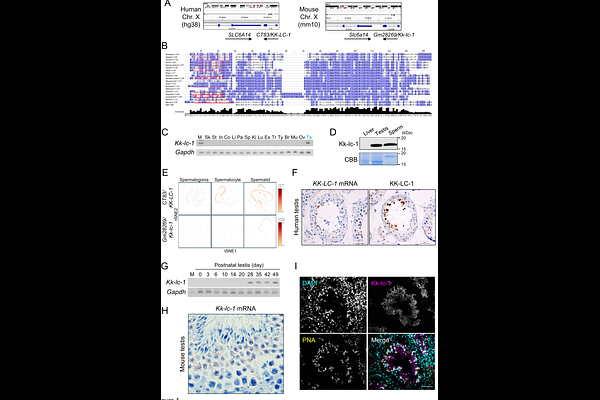
AbstractCT83 (KK-LC-1) is a cancer-testis antigen originally identified in human lung cancer cells and has recently attracted attention as a potential target for cancer therapy. Although KK-LC-1 orthologs have been identified in up to 160 animal species, a murine homolog had not previously been identified, hindering in vivo analysis of its physiological function. In this study, we identified the mouse homolog of KK-LC-1 and performed a comparative analysis of its properties in humans and mice, together with an investigation of its biological function using gene knockout (KO) mice. The murine Kk-lc-1 gene is located on the X chromosome and, like its human counterpart, contains an N-terminal transmembrane domain. In both humans and mice, KK-LC-1 is expressed specifically in the testis and localizes to the head and tail regions of sperm. Analysis of Kk-lc-1-deficient mice revealed normal spermatogenesis, and both male and female KO mice were fertile. However, sperm from Kk-lc-1-deficient males exhibited reduced motility caused by decreased flexibility of the midpiece and failed to penetrate the oocyte zona pellucida in vitro. This defect was rescued by artificial insemination using epididymal sperm, suggesting that maternal factors in vivo may compensate for reduced sperm motility. Although impaired sperm motility during in vitro fertilization (IVF) was rescued by murine Kk-lc-1, functional rescue by human KK-LC-1 was not observed. These findings indicate that KK-LC-1 contributes to sperm motility but is not essential for fertility. Moreover, species-specific differences in KK-LC-1-mediated regulation of sperm motility suggest functional divergence during evolution. The role of KK-LC-1 in sperm motility should therefore be considered in the clinical development of cancer therapies targeting KK-LC-1.