Motor Occupancy Defines Emergent Mechanical States in Cardiac Myosin Ensembles

Motor Occupancy Defines Emergent Mechanical States in Cardiac Myosin Ensembles
Alazzam, O. Y.; Chowdhury, M. A. H.; Stevens, H. M.; Reinemann, D. N.
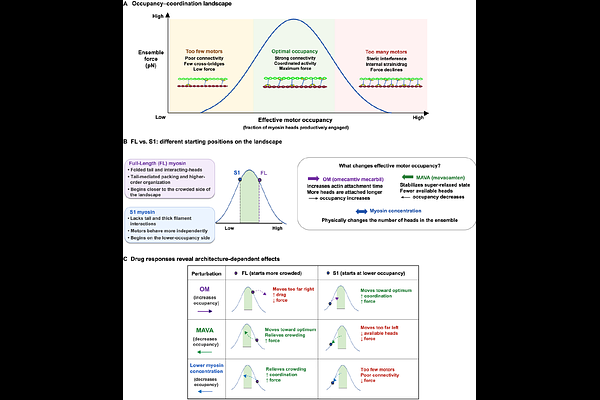
AbstractMyosin II generates force through the collective action of mechanically coupled motor ensembles, yet the mechanisms by which these ensembles sense changes in motor occupancy and coordinate force generation remain poorly understood. Ensemble force production may be governed by an optimal balance between effective motor occupancy and mechanical coordination rather than by motor number alone. We reconstituted cardiac myosin ensembles and systematically perturbed effective motor occupancy using the small-molecule drugs omecamtiv mecarbil (OM), which prolongs actomyosin interactions, and mavacamten (MAVA), which reduces the number of available force-generating myosin heads. Optical trapping measurements of full-length and S1 cardiac myosin ensembles revealed that force generation depended on both myosin concentration and pharmacological perturbation. Reducing myosin concentration increased force generation in the absence of drug, while OM and MAVA produced responses that varied with the initial occupancy state of the ensemble. Low concentrations of MAVA enhanced force generation under high motor occupancy but reduced force under low motor occupancy, whereas OM produced occupancy-dependent changes in both endpoint force and force dynamics. Force traces further revealed changes in the persistence and temporal coordination of force generation. These findings support a model in which cardiac myosin ensembles operate along an occupancy-coordination landscape, where maximal force generation is achieved at an intermediate level of effective motor occupancy. Our results illuminate how changes in motor occupancy are translated into coordinated ensemble mechanics and suggest that emergent mechanical feedback through the shared actin filament may enable ensembles to collectively sense and adapt to their mechanical state.