Vitamin C-Induced Photo-Redox Threshold Enables High-Fidelity Volumetric Printing of Pristine Collagen

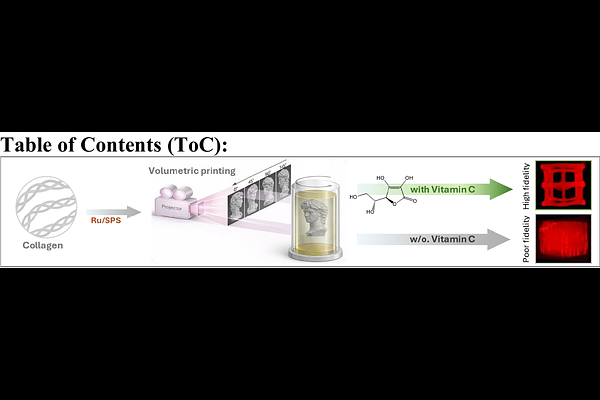
Vitamin C-Induced Photo-Redox Threshold Enables High-Fidelity Volumetric Printing of Pristine Collagen
Wang, B.; Hasenauer, A.; Ivkovic, K.; Frind, A.-S.; Fercher, D.; Zenobi-Wong, M.
AbstractTomographic volumetric printing (TVP) enables rapid fabrication of complex, centimeter-scale 3D architectures. TVP of pristine proteins like collagen is attractive because it better preserves native bioactive motifs that regulate cell-matrix signaling. However, direct TVP of collagen remains challenging because dityrosine crosslinking, driven by visible-light-activated Ru(II)bpy32+/sodium persulfate (SPS), lacks an effective inhibitory mechanism. This results in near-immediate crosslinking upon exposure to light, which leads to an insufficient nonlinear threshold response that fails to suppress background curing. Here, we introduce vitamin C (L-ascorbic acid) as a biocompatible redox regulator to overcome this limitation. UV-Vis kinetics demonstrate that vitamin C suppresses Ru(III) accumulation and scavenges persulfate radicals within Ru/SPS system. This dual action generates a critical photo-redox and crosslinking threshold that inhibits dityrosine formation until vitamin C is depleted. Thereby the threshold response needed for TVP is successfully established, which enables high-fidelity volumetric printing of native collagen. Post-printing construct densification (~53% shrinkage) further improves feature resolution (80 um positive; 120 um negative) and yields mechanically stable and highly stretchable hydrogels (up to 180% strain). Collagen resin with vitamin C supports both cell seeding post-printing and cell-laden printing with high cell density and viability, enabling the rapid biofabrication of cell-instructive 3D microenvironments.