Dynamic dissociation of the IFT complex drives ciliary dysfunction during C. elegans ageing

Dynamic dissociation of the IFT complex drives ciliary dysfunction during C. elegans ageing
Shen, Y.; Li, J.; Wang, S.; Xie, S.; Chen, M.; Song, M.; Zhang, X.; Tang, J.; Li, Q.; Li, D.; Yan, X.
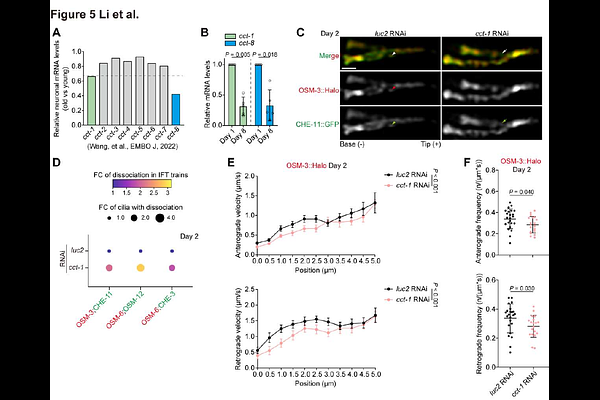
AbstractIntraflagellar transport (IFT) is essential for cilia, and its dysfunction drives ciliopathies and systemic ageing. However, the in vivo dynamics of individual components in the IFT complexes remain obscured, leaving the mechanisms of age-dependent IFT failure largely unknown. Here, we report a dual-color super-resolution imaging strategy to dissect the structural integrity and kinetics of IFT trains in the sensory cilia of young and aged Caenorhabditis elegans. We show that IFT complexes are not static entities. Instead, distinct components undergo dynamic dissociation within IFT trains. This intra-complex dissociation causes a remarkable reduction in IFT velocity and is significantly exacerbated in the cilia of aged worms. Mechanistically, we identify the conserved TRiC/CCT chaperonin complex and daf-19/RFX, the master transcription factor driving IFT genes, as critical regulators of IFT stability. We demonstrate that their age-dependent downregulation drives the progressive IFT component dissociation. Our findings re-frame the IFT complex as a highly dynamic assembly, uncover a new dimension of IFT regulation, and identify the progressive uncoupling of IFT components as a key driver of ciliary dysfunction during ageing.