Elucidating the half-site reactivity mechanism of Salmonella enterica FraB deglycase using native mass spectrometry

Elucidating the half-site reactivity mechanism of Salmonella enterica FraB deglycase using native mass spectrometry
Gao, Y.; Law, J. D.; Gopalan, V.; Wysocki, V. H.
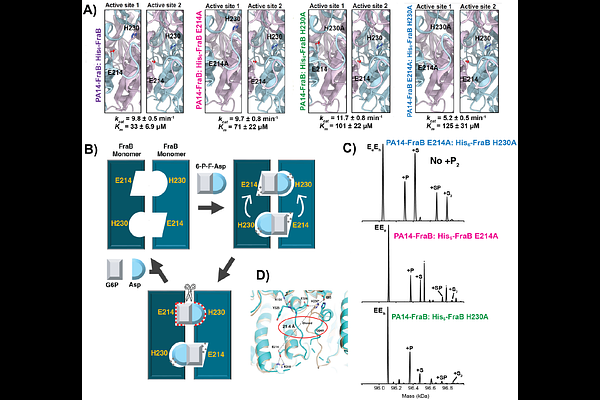
AbstractInter-subunit communication and allosteric regulation are central to the function of oligomeric enzymes, yet these features remain difficult to characterize. Conventional kinetic and structural methods typically yield ensemble averages or static snapshots, thus making it difficult to uncover the dynamic cross-subunit cooperation obligatory for multi-site catalysis by oligomeric enzymes. Here, we investigate Salmonella FraB, a homodimeric deglycase and a potential drug target, to showcase the value of an integrated approach combining native mass spectrometry (nMS), surface-induced dissociation (SID), and kinetic studies to gain insights into catalytic intermediates and inter-subunit communication. By resolving substrate-, product-, and mixed-occupancy species, nMS revealed that both inter-subunit active sites in FraB bind substrate even though only one catalytic center generates the product at any given time. To characterize each active site independently, we designed heterodimers with a mutation that changes the general base or acid in only one active site. Kinetic studies with these mutants indicate that although the two active sites are likely coupled, they do not concomitantly perform cleavage. Consistent with the conformational asymmetry observed in apo-FraB crystal structures, our findings establish a half-site reactivity mechanism in which post-binding conformational changes across the dimer interface restrict substrate cleavage to one active site even though both protomers are able to bind substrate. Importantly, this nMS-based workflow offers a broadly applicable framework for resolving the catalytic states and inter-site communication of oligomeric enzymes that are otherwise difficult to uncover by conventional structural methods.