G-quadruplex folding uncouples cis-activation from collateral trans-cleavage by Cas12a

G-quadruplex folding uncouples cis-activation from collateral trans-cleavage by Cas12a
Safenkova, I. V.; Kamionskaya, M. V.; Samokhvalov, A. V.; Zherdev, A. V.; Dzantiev, B. B.
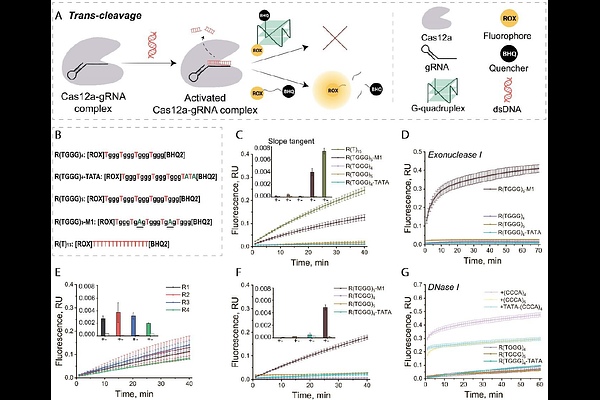
AbstractThe CRISPR/Cas12a system is widely used in nucleic-acid diagnostics because Cas12a couples guide-directed recognition of a cis-target with indiscriminate collateral trans-cleavage of ssDNA. Controlling these activities through DNA structure can tune diagnostic signals. G-quadruplexes (G4s) are strong structural regulators, yet their ability to modulate Cas12a activation and collateral cleavage remains undefined. Here we focused on the G4 scaffold (TGGG)n and tested it with LbCas12a and AsCas12a by real-time cleavage assays, circular dichroism, FRET and denaturing PAGE. In the cis position, compact (TGGG)n G4s activated Cas12a; for the most stable (TGGG)5, kcat/KM was 5.9*10(4) and 8.9*10(4) M(-1) s(-1) for LbCas12a and AsCas12a, respectively. K+ reduced cis-activation rates by approximately 10-fold, depending on scaffold and temperature. FRET and denaturing PAGE showed that productive cis-recognition involves G4 unfolding followed by target-strand cleavage. In the trans position, compact G4s fully resisted collateral reporter cleavage. Core disruption and G-rich non-G4 controls restored reporter cleavage, showing that resistance depends on G4 architecture rather than guanine content. These data define a compact G4 scaffold that remains functionally trans-resistant while retaining guide-dependent cis-target competence. Thus, compact G4 folding provides a programmable structural mechanism for separating Cas12a activation from reporter cleavage, opening a route to signal-gated diagnostic designs.