Cilevirus and dichorhavirus glycoproteins target overlapping host proteins in the Brevipalpus yothersi vector

Cilevirus and dichorhavirus glycoproteins target overlapping host proteins in the Brevipalpus yothersi vector
Chabi de Jesus, C.; Ramos Gonzalez, P. L.; Consoni Bernardino, T.; Oliveira Guardalini, L. G.; Attie Calil Jorge, S.; Tassi, A. D.; Harakava, R.; Watanabe Kitajima, E.; Whitfield, A. E.; Freitas Astua, J.
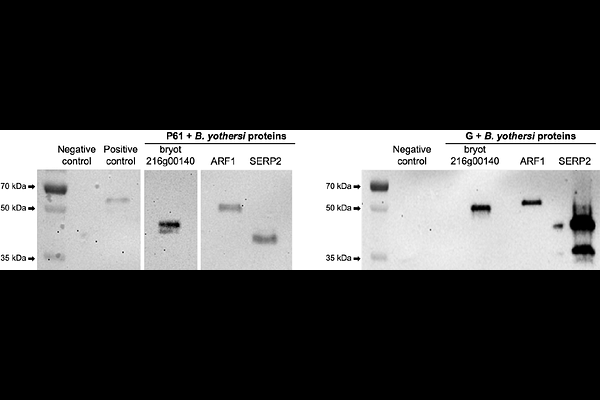
AbstractEnveloped plant viruses are rare, and accumulating evidence suggests deep evolutionary ties to arthropod hosts. Brevipalpus-transmitted viruses (BTVs), which include cileviruses, higreviruses, and dichorhaviruses, are transmitted exclusively by Brevipalpus mites, causing localized infections in plants. Some cileviruses and dichorhaviruses can also replicate within vector cells. Despite their enveloped virions, the involvement of virion structural proteins mediating the interaction with the vector remains unresolved. Here, we investigated the putative glycoproteins P61 of citrus leprosis virus C (CiLV-C; Cilevirus, Kitaviridae) and G of clerodendrum chlorotic spot virus (ClCSV; Dichorhavirus, Rhabdoviridae) to define their interaction networks in the Brevipalpus yothersi vector. Using membrane-based yeast two-hybrid screening with a B. yothersi cDNA library, we identified 73 interactors for P61 and 162 for G, including a shared core set enriched for membrane-associated proteins involved in intracellular trafficking, ER-Golgi dynamics, protein synthesis and folding, and signal transduction. Numerous hypothetical membrane proteins emerged as strong candidates for viral receptors or co-receptors. Three proteins (ARF1, SERP2, and a hypothetical transmembrane protein) were validated by BiFC and Co-IP in Spodoptera frugiperda (Sf9) cells, confirming interactions with both viral proteins in an arthropod-like environment. Together, this work provides the first comprehensive interactome of BTV glyco-like proteins with those of its natural vector and reveals partially convergent host-interaction strategies between phylogenetically distinct viruses, establishing a mechanistic basis for dissecting BTV transmission.